Recent Posts
Introduction: When “Everything Looks Right” but Nothing Converts
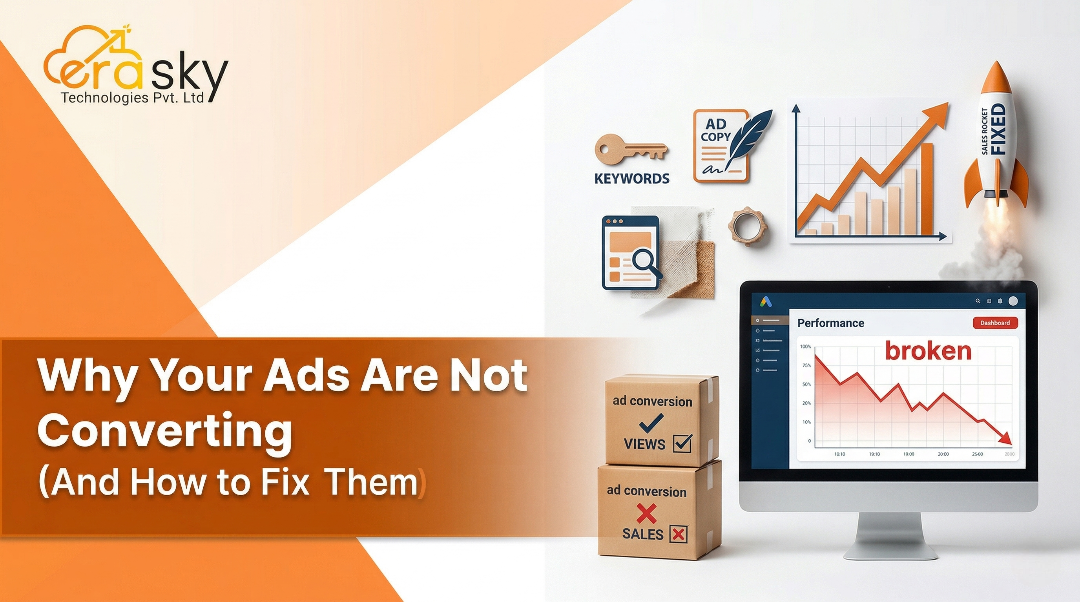
You launch a campaign. The targeting looks sharp. The creatives feel solid. The click-through rate is decent. Traffic is coming in.
And yet… nothing converts.
I’ve seen campaigns where CTR looked healthy and engagement seemed promising, but conversions stayed flat. It feels like the system is working everywhere except where it actually matters.
That frustration has only intensified in the last couple of years.
You are spending more, tracking less, and guessing more than ever before. Even well-structured campaigns across Google, Meta, and Instagram are underperforming. It leaves many asking the same questions:
Why is why my Facebook ads are not converting still a common problem?
Why are Google Ads not converting despite strong keywords?
Why are Instagram ads not converting even with visually appealing creatives?
And most importantly, how to fix low conversion rate ads without burning more budget?
Here’s the uncomfortable truth.
Ads are not failing in isolation anymore. The entire ecosystem around them is often incomplete.
Attention spans are shorter. Trust is lower. Tracking is weaker. Competition is sharper.
Fixing conversion issues today requires system-level thinking, not surface-level tweaks.
The New Reality of Ad Conversions (Why It’s Harder Than Ever)
Signal Loss and Attribution Blind Spots
The data you rely on is no longer as reliable as it used to be.
iOS privacy updates have reduced trackable user behavior by up to 80 percent. Third-party cookies are fading out, and platforms are leaning heavily on modeled data and AI predictions.
What this means is simple.
You might think your ads are not converting. In reality, you might not be seeing the full picture.
This leads to slower optimization cycles and misleading performance metrics. Many cases of Google Ads not converting are actually cases of broken attribution.
Rising Costs Are Raising the Stakes
Ad costs are no longer forgiving.
Meta CPMs have increased significantly over the past few years, and Google Ads CPCs have climbed across competitive industries.
This creates a new pressure point.
What worked at a 2 percent conversion rate earlier may now be unprofitable. Margins are tighter, and efficiency matters more than ever.
Attention Is Brutally Short
You are not competing with other ads. You are competing with infinite scroll.
Users decide within 2 seconds whether your ad deserves attention. Most don’t even consciously register what they scroll past.
A weak hook is not just ineffective. It is invisible.
Consumers Don’t Trust Ads Alone Anymore
People no longer convert after a single interaction.
They research. They compare. They look for validation.
Reviews, testimonials, and brand presence across platforms matter more than the ad itself.
Ads do not convert anymore. Ecosystems do.
The Real Reasons Your Ads Are Not Converting (Deep Dive)
Poor Offer-Market Fit (The Silent Killer)
You can have great creatives and still fail.
If the offer does not resonate, nothing else matters.
Common signs include high clicks but no conversions. People are curious, but not convinced.
This usually comes down to weak differentiation or lack of urgency.
Strong offers focus on outcomes, not features. They make the decision feel obvious.
Weak Creative (The #1 Bottleneck Today)
Creative is no longer a support function. It is the main driver.
Most underperforming campaigns share one thing in common. The first few seconds fail to capture attention.
If your ad feels like an ad, it is already at a disadvantage.
High-performing brands focus on native storytelling, relatable content, and volume. They test aggressively and iterate fast.
Audience Targeting Misalignment
Targeting has changed.
Overly narrow audiences limit scale. Overly broad ones waste budget.
Platforms now reward better inputs rather than tighter control.
First-party data, lookalike audiences, and AI-driven optimization are shaping performance.
Landing Page Disconnect (The Conversion Leak)
This is where most conversions are lost.
A user clicks your ad expecting one thing and lands on something slightly different. That friction is enough to break the flow.
Even small issues like slow load speed or unclear messaging can drop conversions dramatically.
Consistency between ad, headline, and offer is critical.
Lack of Trust Signals
People hesitate before they buy.
Without proof, they leave.
Strong trust signals include testimonials, case studies, reviews, and guarantees. These elements often determine whether a user converts or abandons.
Broken Funnel Structure
Expecting cold traffic to convert instantly is unrealistic.
Users need stages.
Awareness builds interest. Consideration builds trust. Conversion closes the deal.
Skipping stages leads to poor performance, no matter how good the ad looks.
Wrong Metrics (Optimization Blindness)
Clicks are not conversions.
Optimizing for vanity metrics leads to misleading decisions.
Metrics like conversion rate, customer acquisition cost, and overall efficiency provide a clearer picture.
Frequency Fatigue
Even good ads wear out.
When users see the same creative repeatedly, performance drops. This is why ongoing creative refresh is not optional.
Platform-Specific Misalignment
Each platform behaves differently.
What works on Instagram might fail on Google.
For example, Instagram ads not converting often lack native feel, while Google Ads not converting often suffer from poor intent alignment.
Understanding platform behavior is essential.
Tracking and Attribution Errors
Sometimes, conversions are happening. You just cannot see them.
Without proper tracking systems, campaigns appear underperforming when they are not.
This creates false negatives and poor optimization decisions.
Conversion Benchmarks You Should Actually Care About (2025–2026)
Benchmarks give you context.
Meta Ads typically perform well between 1 to 3 percent CTR, with strong campaigns exceeding that. Conversion rates generally range from 2 to 5 percent, with higher-performing funnels reaching up to 10 percent.
Google Ads search campaigns usually convert between 3 to 7 percent, depending on intent.
Landing pages average around 2 to 4 percent, with optimized ones hitting significantly higher.
If your numbers fall below these ranges, the issue is not random. It is diagnosable.
How to Fix Ads That Are Not Converting (A Practical Framework)
Diagnose Before You Fix
Start by identifying the real problem.
Low CTR points to creative issues.
High CTR but low conversions suggests problems with the offer or landing page.
Traffic without sales indicates trust or funnel gaps.
Fix in the Right Order
Most businesses fix things in the wrong sequence.
The correct order is simple.
Creative first.
Then the offer.
Then the landing page.
Then the audience.
Then the funnel.
This order maximizes impact.
Testing Framework That Actually Works
Testing should be structured.
Run multiple ad sets. Test multiple creatives. Isolate variables.
Hooks, formats, and messaging angles should all be explored.
Consistency in testing leads to clarity in results.
Build a Conversion Ecosystem (Not Just Ads)
Ads alone are no longer enough.
You need supporting systems.
Organic content builds familiarity. Retargeting reinforces messaging. Email and follow-ups build trust.
This is where many businesses struggle. They focus on campaigns but ignore infrastructure.
This is also where experienced execution partners like Era Sky Technologies bring clarity. Instead of isolated fixes, the focus shifts to building connected systems that support conversion at every stage.
Key Trends Defining Ad Conversions in 2026
AI-Driven Campaigns Are Taking Over
Automation is no longer optional.
Campaign types like Performance Max and Advantage Plus are shaping the future. Success now depends on feeding these systems the right inputs.
Creative Volume Beats Precision Targeting
More creatives mean more learning.
Brands that produce consistently outperform those that rely on a few polished assets.
First-Party Data Is a Competitive Advantage
Owning your data is becoming critical.
Email lists, CRM systems, and direct customer insights outperform traditional tracking.
UGC and Creator Content Win
User-generated content feels real.
It blends into feeds naturally and builds trust faster than traditional ads.
Multi-Touch Attribution Is the New Reality
Conversions rarely happen in one step.
Users interact with brands multiple times before taking action.
Understanding this journey is essential for accurate optimization.
Interesting Facts That Most Advertisers Miss
Most users need 5 to 12 interactions before converting, not just one click.
Ads with social proof can convert up to three times better than those without it.
A one-second delay in page load time can reduce conversions by nearly 20 percent.
Creative testing contributes more to performance gains than audience targeting in most modern campaigns.
Brands that align messaging across ads and landing pages see significantly higher retention and repeat conversions.
Final Take: Ads Don’t Fail, Systems Do
When ads do not convert, it is rarely just an ad problem.
It is usually a mix of weak messaging, misaligned offers, broken funnels, missing trust signals, and incomplete tracking.
That is why isolated fixes rarely work.
The brands that succeed today are not just running better ads. They are building better systems.
They understand how creative, data, user experience, and trust all connect.
Conclusion
Ad performance today is not about spending more. It is about connecting better.
Conversions happen when everything aligns. The message, the offer, the experience, and the trust.
If your campaigns are struggling, the solution is not to push harder. It is to step back and identify the weakest link.
Sometimes, that process requires an outside perspective. Not just to run campaigns, but to understand what is limiting performance and rebuild it properly.
This is where a structured, execution-focused approach makes a real difference. Teams like Era Sky Technologies focus on fixing what actually impacts results rather than chasing surface-level improvements.
If you are serious about improving conversions, start with a full funnel audit. Identify what is breaking the system. Fix that first.
Because once the system works, scaling becomes a decision, not a risk. Contact us to learn more!
FAQs
Why are my Facebook ads not converting despite high traffic?
Often due to weak offers, landing page mismatch, or lack of trust signals rather than poor traffic quality.
How do I fix low conversion rate ads quickly?
Focus on creative and landing page alignment first. These are the fastest and most impactful fixes.
Why are my Google Ads not converting even with good keywords?
This usually comes down to intent mismatch, weak landing pages, or tracking issues.
What is a good conversion rate for ads in 2026?
Typically between 2 to 5 percent on average, with strong campaigns reaching up to 10 percent.
Do Instagram ads convert differently than Facebook ads?
Yes. Instagram prioritizes native, visually engaging content that feels less like advertising.
How many creatives should I test per campaign?
At least 5 to 10 creatives per ad set for meaningful optimization and learning.