Recent Posts
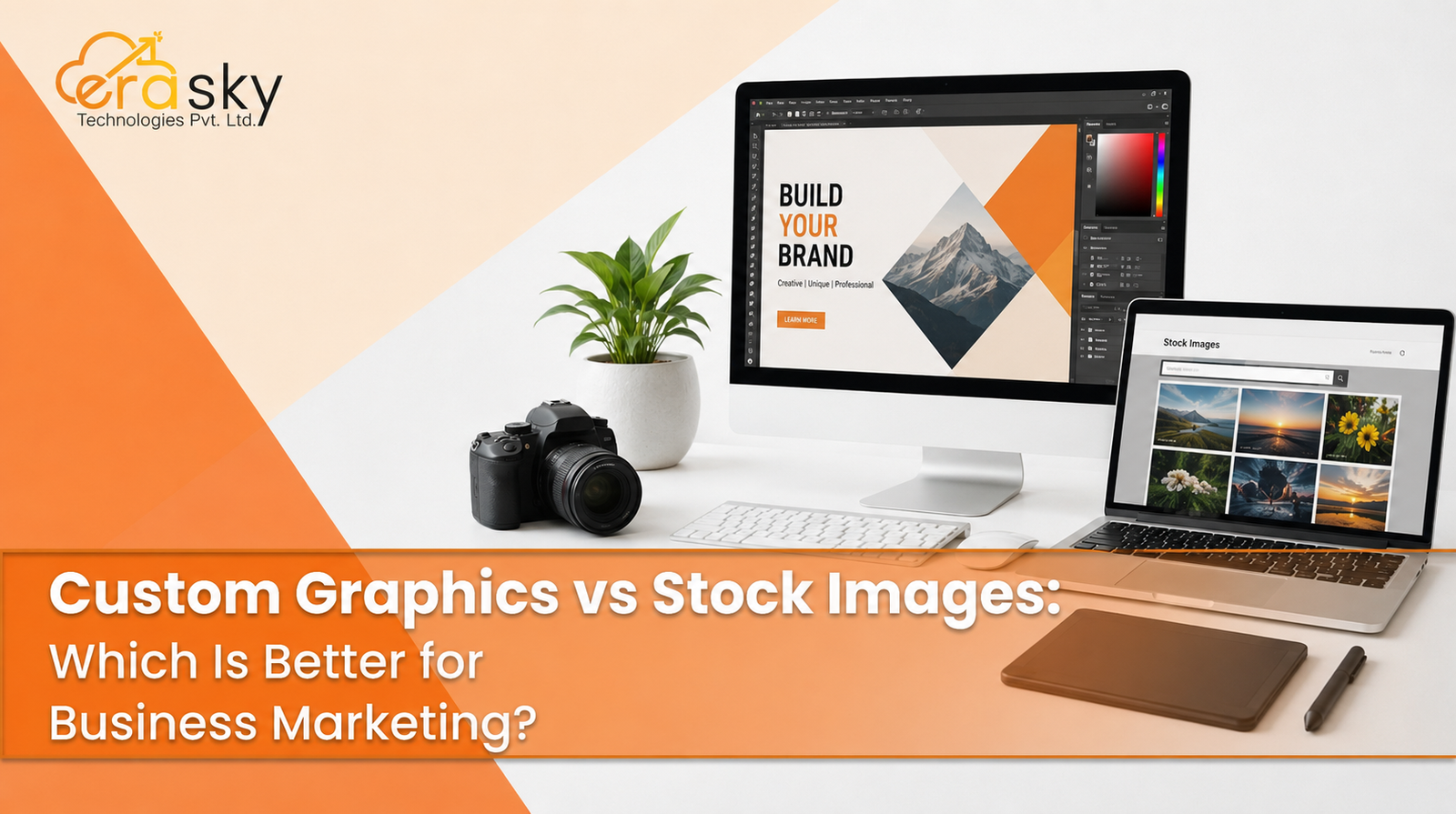
Visual content has quietly become one of the biggest influences on how customers perceive a business. Whether someone lands on your website, scrolls through your social media, opens your email newsletter, or sees your advertisement for the first time, the visuals often create an impression long before the words do.
Imagine two businesses offering similar products at comparable prices. One presents a polished website filled with cohesive illustrations, branded icons, informative graphics, and consistent visual storytelling. The other relies on familiar stock photos that visitors have likely encountered across dozens of unrelated websites. Even before comparing products or services, many customers instinctively form opinions about professionalism, credibility, and quality.
This is why the conversation around custom graphics versus stock images has evolved dramatically over the past few years.
Previously, businesses mainly asked which option was more affordable. Today, thanks to AI-assisted design tools, expanding stock libraries, and growing customer expectations, the real question has become far more strategic.
Which approach builds stronger trust? Which creates a recognizable identity? Which delivers better long-term marketing performance?
The answer is no longer black and white.
While stock images continue to serve an important purpose, businesses investing in custom graphic design are increasingly building stronger brands, improving customer engagement, and creating memorable experiences that competitors find difficult to replicate.
This article explores both approaches from every important perspective, including branding, psychology, SEO, marketing performance, copyright, scalability, AI, and return on investment, helping business owners and founders make informed decisions that support long-term growth.
The Current Landscape of Business Marketing Visuals
Visual communication is no longer an optional enhancement to marketing. It has become one of its foundational elements.
Today's businesses rely on visuals across virtually every customer touchpoint. Websites, landing pages, blogs, product pages, email campaigns, presentations, brochures, catalogs, paid advertisements, social media platforms, and packaging all depend on effective visual communication to capture attention and explain value.
Customers consume enormous amounts of content every day. As attention spans become increasingly fragmented, visuals often determine whether users continue engaging or move on within seconds.
The Rise of AI-Assisted Visual Creation
Perhaps the biggest shift between 2024 and 2026 has been the widespread adoption of AI across creative workflows.
Businesses can now generate illustrations, expand backgrounds, remove unwanted elements, create product concepts, develop icons, and produce multiple design variations in minutes rather than days.
Stock image providers have also embraced AI by integrating intelligent editing features into their platforms. Instead of downloading a standard image, businesses can modify backgrounds, adjust compositions, personalize colors, or generate variations while remaining within commercial licensing frameworks.
Rather than replacing designers, AI has become an accelerator.
It speeds up production, simplifies repetitive tasks, and expands creative possibilities. However, it still relies heavily on human strategy to ensure every visual aligns with brand identity and business objectives.
Why Traditional Stock-Only Marketing Feels Less Effective
Modern audiences have become remarkably skilled at recognizing generic imagery.
The smiling office team gathered around a laptop.
The perfectly posed customer service representative wearing a headset. The generic handshake between executives.
These visuals once represented professionalism. Today, they often communicate the opposite because customers have seen them repeatedly across unrelated industries.
As digital competition grows, familiarity without authenticity can reduce emotional connection. Businesses that rely exclusively on widely used imagery may unintentionally weaken their differentiation, even when their products or services are exceptional.
Consumers increasingly reward brands that feel original, transparent, and authentic. That shift has elevated the importance of marketing graphics designed specifically around a company's identity rather than borrowed from a shared library.
Custom Graphics vs Stock Images: Understanding the Real Challenge
Many businesses believe the debate revolves around choosing the better image type.
In reality, the bigger issue is choosing visuals that support business objectives.
A visually attractive image that fails to communicate your message, reinforce your brand, or guide customers toward action contributes little to marketing success.
The strongest visual strategy begins with understanding why businesses often struggle in the first place.
Generic Branding Creates Invisible Businesses
Brand recognition is built through repetition and consistency.
Businesses known for distinctive colors, icon styles, illustration techniques, layouts, and visual storytelling become easier to remember over time.
Generic visuals interrupt this process.
When competitors use similar imagery from the same stock libraries, customers struggle to distinguish one company from another.
Over time, this weakens brand recall and reduces the emotional connection that encourages repeat business.
By contrast, custom graphics establish a visual language unique to a business. Every illustration, diagram, infographic, and banner contributes to an identity customers begin recognizing almost instinctively.
Weak Visual Hierarchy Confuses Visitors
Every marketing visual should direct attention intentionally.
Visitors should immediately understand:
- What the business offers
- Why it matters
- What action to take next
Poorly selected visuals often distract rather than clarify.
Beautiful photography cannot compensate for confusing layouts, inconsistent branding, or weak messaging.
Purpose-built graphics solve this challenge by simplifying information, emphasizing priorities, and guiding customers naturally through each stage of the buying journey.
Low Trust Signals Reduce Conversions
Customers evaluate credibility within moments
.
Professional visuals communicate investment.
They suggest the business pays attention to detail.
They imply reliability.
Conversely, heavily reused stock images can unintentionally create distance between businesses and their audiences because they feel staged rather than authentic.
While customers may not consciously identify why a website feels generic, they often sense it.
Those subtle perceptions influence trust, engagement, and ultimately purchasing decisions.
Businesses Without Design Systems Create Inconsistency
One of the most overlooked problems in marketing is inconsistency.
A website uses one illustration style.
Social media uses unrelated templates.
Presentations feature random icons.
Advertisements introduce entirely different color palettes.
Although each individual asset may look acceptable, together they weaken brand recognition.
Successful businesses rarely create visuals one piece at a time.
Instead, they build visual systems that define typography, spacing, iconography, illustration style, colors, and layouts across every customer interaction.
AI Without Strategy Produces Average Results
AI can generate impressive visuals quickly.
However, speed does not guarantee effectiveness.
Without clear direction, AI often produces graphics that lack personality, strategic messaging, and consistent branding.
Businesses that simply generate visuals without creative oversight risk filling their marketing with inconsistent assets that feel disconnected.
AI works best when guided by experienced designers who understand business positioning, customer psychology, and visual storytelling.
Key Factors That Influence Marketing Performance
Choosing between custom graphics and stock images requires evaluating several business factors rather than focusing on cost alone.
Brand Identity
One of the greatest advantages of custom graphic design is ownership.
Every illustration, icon, chart, or banner reflects the personality of the business itself.
Customers begin associating recurring design patterns with the company, strengthening recognition over time.
Stock imagery, while versatile, rarely creates this level of familiarity because identical assets often appear across multiple brands.
Customer Trust
People naturally trust businesses that appear organized, thoughtful, and consistent.
Original graphics demonstrate effort.
They communicate that the company invested in presenting information clearly rather than relying solely on convenient solutions.
This perception becomes particularly important in industries where trust influences purchasing decisions, including consulting, healthcare, manufacturing, software, finance, and professional services.
Speed of Production
There is no denying the efficiency of stock libraries.
A licensed image can be found, downloaded, and implemented within minutes.
Custom projects require planning, concept development, reviews, revisions, and refinement.
For urgent campaigns or temporary content, stock imagery often provides practical value.
The key is understanding when speed outweighs differentiation and when it does not.
Cost Versus Long-Term Value
Stock images generally require lower upfront investment through subscriptions or individual licenses.
Custom graphics involve greater initial costs because they require creative expertise.
However, comparing only upfront expense overlooks long-term value.
Branded illustrations, reusable templates, icon systems, presentation assets, social media frameworks, and infographics continue generating value across multiple campaigns for years. Viewed as business assets rather than isolated expenses, professionally created graphics often produce significantly greater returns over time.
SEO Benefits Beyond Rankings
A common misconception is that Google automatically rewards websites using original visuals.
That is not how search engines work.
Search engines evaluate overall user experience rather than simply identifying whether an image is custom or licensed.
However, high-quality marketing graphics indirectly contribute to stronger SEO by encouraging longer engagement, increasing content sharing, reducing bounce rates, and attracting backlinks when original infographics or visual data become valuable references.
Proper optimization through descriptive filenames, meaningful alt text, compression, and strategic placement remains essential regardless of image source.
Conversion Performance
Visuals influence buying decisions far more than many businesses realize.
Clear diagrams explain complex services.
Infographics simplify technical information.
Custom illustrations highlight unique selling points.
Branded graphics reinforce professionalism.
Each of these factors helps visitors move closer to conversion.
Stock imagery performs adequately for supporting content, but purpose-built visuals generally outperform generic assets when persuasion and clarity become priorities.
Strategic Fixes and a Smarter Visual Framework
Rather than viewing custom graphics and stock images as competing solutions, successful businesses increasingly combine both through structured visual planning.
A practical approach is to reserve custom assets for the moments that define the brand.
Website banners, product explainers, advertising creatives, sales presentations, landing pages, brochures, and premium business marketing materials benefit significantly from original design because these assets shape customer perception and influence purchasing decisions.
Stock imagery remains valuable for supporting blog articles, editorial content, internal documentation, seasonal campaigns, and temporary promotions where speed and flexibility are more important than exclusivity.
AI then acts as a productivity layer, helping teams generate concepts, explore creative directions, create variations, and accelerate revisions without replacing strategic design thinking. This balanced approach allows businesses to manage budgets effectively while steadily building stronger visual equity over time.
Systems Thinking: Why Great Visuals Need a Bigger Strategy
One of the biggest mistakes businesses make is treating design as a collection of isolated projects.
A new website banner.
A brochure for an exhibition.
A social media campaign.
An email template.
A product catalog.
Each project may succeed individually, but customers experience them collectively. When visuals lack consistency, businesses unintentionally dilute their own identity. The strongest brands are built through connected systems where every visual reinforces the same personality, values, messaging, and customer expectations. That is why visual strategy extends beyond creating attractive graphics. It involves understanding how branding, user experience, content marketing, SEO, advertising, and customer psychology work together.
Businesses increasingly recognize that sustainable growth requires more than attractive designs. It requires a structured creative ecosystem where every visual asset supports broader marketing objectives.
This is where experienced creative partners add measurable value. Rather than producing isolated designs, companies such as Era Sky Technologies focus on developing cohesive visual ecosystems that align websites, advertising creatives, social media assets, presentations, and other marketing design elements into one recognizable brand experience. The result is not simply better-looking visuals. It is stronger consistency, clearer communication, and a marketing presence that becomes easier for customers to recognize, trust, and remember.
Data, Benchmarks, and Performance Metrics
One of the biggest mistakes businesses make when evaluating visuals is focusing on aesthetics alone. A design may look impressive, but if it fails to increase engagement, improve user understanding, or support conversions, it is not delivering meaningful business value. The most effective marketing graphics are measured by performance rather than personal preference.
The Numbers Behind Visual Marketing in 2025 and 2026
The visual content industry continues to expand despite rapid advances in AI. According to recent market analyses, the global stock photography market was valued at approximately $4.34 billion in 2024 and is projected to exceed $5.6 billion by 2029, with some long-term forecasts estimating growth beyond $10 billion by 2034. This continued expansion reflects a simple reality: businesses still rely heavily on visual content, even as the methods of creating it evolve.
At the same time, royalty-free licensing now accounts for a significant share of the market, demonstrating that organizations continue seeking flexible, commercially safe visual assets. Meanwhile, AI-assisted editing has become a standard feature across many leading stock platforms, allowing businesses to personalize licensed images without abandoning existing workflows.
These trends reveal that the discussion is no longer about replacing one option with another. Instead, it is about using each resource more intelligently.
Website Performance Metrics That Matter
Business owners often celebrate attractive website designs while overlooking how visitors actually interact with them.
Instead of judging visuals by appearance alone, monitor metrics such as:
- Bounce rate
- Average time on page
- Scroll depth
- Click-through rate
- Landing page conversion rate
- Form submissions
- Product inquiries
When custom visuals simplify complex information and reinforce trust, these indicators frequently improve because visitors understand the offering more quickly and feel more confident taking the next step.
Social Media Success Goes Beyond Likes
Algorithms increasingly reward originality.
While engagement patterns vary across platforms, original branded visuals generally encourage stronger long-term performance because audiences recognize them more easily.
Instead of chasing likes alone, businesses should evaluate:
- Saves
- Shares
- Comments
- Profile visits
- Follower growth quality
- Brand mentions
- Returning audience engagement
These signals provide a clearer picture of whether visual content is genuinely strengthening brand awareness.
Advertising Performance
Paid advertising places visuals under immediate scrutiny.
Every creative competes against countless others within seconds.
Businesses should regularly monitor:
- Click-through rate (CTR)
- Cost per click (CPC)
- Cost per acquisition (CPA)
- Return on ad spend (ROAS)
- Conversion rate
- Creative fatigue
Repeated stock images can sometimes contribute to declining ad performance because audiences become familiar with commonly used visuals. Refreshing campaigns with original creative assets often helps extend campaign effectiveness and improve engagement.
Measuring Brand Strength
Not every important metric appears inside an analytics dashboard.
Businesses should also evaluate qualitative indicators, including:
- Visual consistency across channels
- Customer perception of professionalism
- Brand recognition
- Sales presentation quality
- Marketing material consistency
- Internal design efficiency
Strong brands are built through repeated positive impressions, and visuals play a major role in creating those impressions.
Emerging Trends Shaping Business Marketing
The visual marketing landscape continues evolving rapidly. Businesses that understand where the industry is heading can make smarter investments today rather than reacting tomorrow.
Authenticity Is Becoming More Valuable Than Perfection
Consumers increasingly prefer visuals that feel genuine rather than artificially polished. Realistic illustrations, authentic product imagery, behind-the-scenes photography, and original branded graphics often outperform highly staged visuals because they feel more believable. Businesses are discovering that trust grows through honesty, not excessive perfection.
AI Is Becoming a Creative Assistant
Much of the discussion around artificial intelligence focuses on replacement.
In reality, AI has become a productivity tool.
Designers now use AI to:
- Generate concepts
- Explore multiple directions
- Create rapid mockups
- Expand backgrounds
- Remove distractions
- Produce visual variations
However, strategy, storytelling, and brand consistency still depend on human expertise.
The businesses achieving the strongest results are those combining AI efficiency with experienced creative direction.
Hybrid Visual Workflows Are Becoming Standard
Very few successful brands rely exclusively on one source of visual content.
Instead, they combine:
- Original photography
- Custom graphics
- Licensed stock images
- AI-assisted editing
- Motion graphics
- Interactive visuals
Each serves a different purpose while contributing to a unified brand experience.
Licensing Is Receiving Greater Attention
As AI-generated and AI-modified assets become more common, copyright policies continue evolving. Businesses should carefully review licensing agreements before using visuals commercially, particularly for advertising, packaging, merchandise, or resale. Maintaining documentation for licensed assets has become an increasingly important part of professional marketing operations.
Visual Identity Is Becoming a Competitive Advantage
Products can often be copied.
Pricing can change.
Services can evolve.
But a recognizable visual identity becomes increasingly difficult for competitors to imitate. Businesses investing consistently in custom graphic design build familiarity over time, making their marketing easier to recognize across websites, social media, advertising, presentations, and customer communications.
Interesting Insights You May Not Know
One of the fascinating aspects of visual marketing is how subtle details influence customer behavior. Here are several insights that many businesses overlook.
Customers Often Recognize Stock Photos Without Realizing It
People may not remember where they previously saw a particular image, but repeated exposure creates familiarity. That familiarity can reduce originality and make brands appear less distinctive.
Original Infographics Can Earn Natural Backlinks
When businesses publish informative graphics containing valuable research or simplified explanations, other websites frequently reference and link to them. These backlinks can indirectly strengthen SEO authority over time.
AI Cannot Replace Brand Memory
AI can create visuals quickly, but it cannot independently develop a recognizable visual language that customers associate with a specific business. That consistency still comes from thoughtful creative direction.
Simplicity Often Converts Better Than Complexity
Many high-performing visuals are surprisingly simple. Clear layouts, focused messaging, and purposeful illustrations frequently outperform overloaded designs filled with unnecessary decorative elements.
Small Design Systems Create Big Business Impact
Even a modest collection of branded icons, templates, illustrations, and presentation styles can dramatically improve consistency across all business marketing materials, making smaller businesses appear significantly more established.
Trust Is Built Through Repetition
Customers rarely trust a business after seeing one advertisement. Recognition develops gradually through repeated exposure to consistent messaging and visuals. Every professionally designed asset contributes to that ongoing relationship.
Final Analysis: The Better Question to Ask
After examining branding, psychology, SEO, conversion performance, AI, licensing, scalability, and long-term business value, one conclusion becomes increasingly clear. The real question is not whether custom graphics are universally better than stock images. The better question is whether your visuals are helping customers understand, trust, and remember your business.
Each option serves a purpose. Stock images provide speed, convenience, and affordability. They remain valuable for editorial content, temporary campaigns, supporting blog posts, and situations where originality is not the primary objective.
Custom graphics, however, become increasingly valuable wherever differentiation matters.
They strengthen brand recognition.
They simplify complex ideas.
They improve consistency.
They reinforce professionalism.
They create visual assets that competitors cannot easily duplicate.
AI has added another dimension by making creative production faster and more accessible. Yet AI does not eliminate the need for strategic thinking. Instead, it amplifies the importance of having a clear visual direction before creating any asset. Businesses that treat visual content as a long-term investment rather than a collection of isolated projects are better positioned to build stronger customer relationships, improve marketing efficiency, and create sustainable competitive advantages.
Conclusion
Choosing between custom graphics and stock images is no longer about selecting one winner. Successful businesses understand that different marketing objectives require different visual solutions. Stock images continue to provide exceptional value for speed, flexibility, and supporting content. They remain an important resource within modern marketing workflows.
At the same time, businesses seeking stronger brand recognition, improved customer trust, higher-quality marketing graphics, and more effective business marketing materials increasingly invest in custom graphic design because it creates something far more valuable than attractive visuals. It creates a recognizable identity.
The most resilient strategy for 2026 is a balanced visual system where custom assets define the brand, stock imagery supports tactical needs, and AI accelerates creative production without compromising consistency.
Building that kind of system requires more than design software or image libraries. It requires an understanding of how branding, user experience, content strategy, and visual communication work together to influence customer decisions. That is why many businesses choose to work with experienced creative partners who approach design from a broader business perspective rather than simply producing individual graphics. Era Sky Technologies follows this philosophy by helping organizations develop cohesive visual ecosystems where websites, advertising creatives, presentations, social media content, and other marketing design assets consistently reinforce the same brand identity and business objectives.
When every visual communicates the same level of professionalism, clarity, and purpose, marketing becomes more than attractive design. It becomes a strategic business asset that supports growth, strengthens trust, and creates lasting recognition in increasingly competitive markets. Connect with us if you want professional graphic design services for your brand or business!
FAQs
1. Are custom graphics always better than stock images?
Not necessarily. Custom graphics are ideal for branding, advertising, websites, and conversion-focused campaigns, while stock images remain useful for blog content, editorial materials, and projects requiring quick turnaround. Most businesses benefit from combining both strategically.
2. Do stock images negatively affect SEO?
No. Search engines do not rank pages lower simply because they use stock images. SEO benefits come from proper optimization, user engagement, page experience, descriptive alt text, image compression, and valuable content rather than image source alone.
3. When should a business invest in custom graphic design?
Businesses should prioritize custom graphic design when developing brand identity, product explainers, landing pages, advertising campaigns, sales presentations, infographics, and other high-impact marketing assets where differentiation and trust directly influence customer decisions.
4. Can AI replace graphic designers?
AI significantly improves design efficiency by assisting with concepts, variations, and editing. However, it cannot replace strategic thinking, brand development, storytelling, or creative direction. Human expertise remains essential for building a consistent visual identity.
5. Are stock images safe for commercial use?
Yes, provided they are used according to the licensing terms established by the provider. Businesses should carefully review commercial rights, usage restrictions, print limitations, redistribution policies, and AI-related licensing updates before publishing.
6. What is the best visual strategy for business marketing in 2026?
A hybrid approach offers the greatest long-term value. Invest in custom graphics for branding and customer-facing assets, use stock images where speed and flexibility are priorities, leverage AI to improve efficiency, and maintain consistent marketing design standards across every customer touchpoint.