Recent Posts
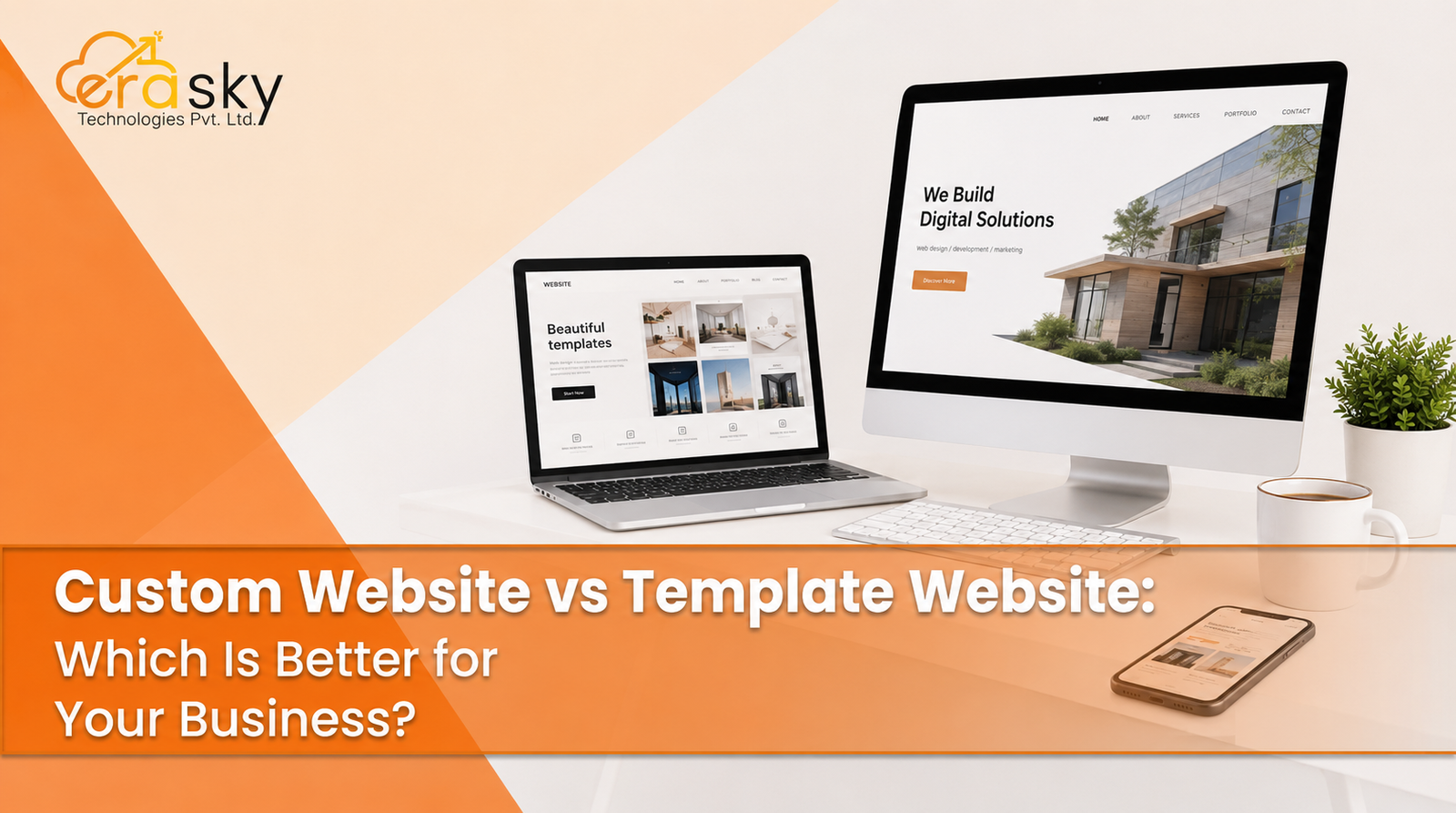
A founder planning a new website usually faces one clear question first: should I use a ready-made template or invest in a custom website? On the surface, the answer seems simple. A template is faster and cheaper. A custom website takes more time, more planning, and a higher initial budget. But once your website becomes more than a digital visiting card, the decision becomes deeper.
In 2026, the debate around custom website vs template is no longer only about design and cost. Your website now affects how customers judge your brand, how search engines understand your business, how AI-driven discovery tools read your content, how quickly your pages load, how easily users convert, and how far your digital presence can scale.
For a small business that simply needs a clean online presence, business website templates can be a practical starting point. But for a business that depends on leads, trust, SEO, automation, online sales, or long-term digital growth, custom development often creates stronger value. The real question is not which option is universally better. The smarter question is which one fits your business goals, growth stage, and future plans.
The Current Website Landscape in 2026
A few years ago, businesses mostly compared templates and custom websites using two factors: price and launch time. Today, that comparison has changed completely. AI website builders, no-code platforms, WordPress themes, Shopify themes, Webflow templates, Framer templates, and drag-and-drop builders have made website creation easier than ever. This has helped startups, freelancers, local businesses, and early-stage brands launch faster. A website that once required weeks can now be built in a few days if the content, images, and basic structure are ready.
But customer expectations have also increased. People expect websites to be fast, mobile-friendly, visually trustworthy, easy to navigate, and clear within seconds. Search engines expect clean structure, helpful content, strong technical foundations, and better user experience. AI search tools increasingly depend on structured information, semantic clarity, FAQs, schema, and trustworthy brand signals.
This means a modern website is no longer judged only by how attractive it looks. It is judged by how well it performs as a complete business system. The old belief that templates are always weak and custom websites are always superior is not accurate anymore. A well-built template website can perform better than a poorly planned custom website. At the same time, a strategically built custom website can outperform a template when the business needs strong branding, SEO, conversion optimization, integrations, and scalability.
What Is a Template Website?
A template website is built using a pre-designed layout or theme. The structure already exists, and the business customizes it by adding its own logo, colors, images, text, services, products, and contact details.
Common platforms include WordPress themes, Wix, Squarespace, Shopify themes, Webflow templates, Framer templates, and AI website builders. These options are popular because they reduce time, cost, and technical complexity. For example, a consultant may select a professional service template, replace the demo content, add testimonials, connect a form, and publish the website within a week. For a new business testing an offer, this can be a smart and realistic choice.
The strength of templates lies in speed and affordability. They are useful for portfolios, MVPs, small business websites, basic landing pages, personal brands, and brochure-style websites. Many templates are also responsive, visually polished, and easy to edit.
However, the limitations start appearing when the business needs more control. Templates often restrict layout flexibility, advanced SEO structure, custom user journeys, unique design language, and deeper integrations. Many also come with extra code, plugins, or app dependencies that may affect speed and long-term maintenance. In the comparison of website templates vs custom design, templates win on convenience, but they can become restrictive as the business grows.
What Is a Custom Website?
A custom website is designed and developed specifically for a business. Instead of fitting the brand into an existing layout, the website is planned around the brand’s goals, audience, content, user journey, technical needs, and future growth.
Custom development usually includes discovery, strategy, information architecture, UX planning, UI design, frontend development, backend development if required, CMS setup, SEO structure, performance optimization, testing, and maintenance.
Customization does not only mean changing colors or fonts. It can include custom forms, landing pages, dashboards, booking systems, payment flows, CRM integrations, product filters, animations, content structures, schema markup, analytics tracking, automation, and personalized conversion paths.
This is where custom website development services become valuable. A business that wants its website to generate leads, explain complex services, build trust, support SEO, or connect with internal systems needs more than a nice-looking layout. It needs a planned digital foundation.
Custom websites are especially useful for B2B companies, service-based businesses, e-commerce brands, SaaS companies, healthcare brands, education businesses, real estate companies, export businesses, high-ticket service providers, and brands competing in crowded markets.
The only catch is quality. Custom does not automatically mean better. A custom website without strategy, strong content, clean UX, and technical discipline can still underperform. The value of custom development depends heavily on the team building it.
Custom Website vs Template Website: The Core Problem
The biggest mistake business owners make is choosing based only on upfront cost. A template may look cheaper today, but if your business later needs SEO expansion, CRM integration, custom landing pages, automation, advanced analytics, or a full redesign, that low-cost decision can become expensive.
The second mistake is treating design as decoration. Website design is not just about looking modern. It influences trust, attention, clarity, navigation, and decision-making. A user should quickly understand what you offer, why it matters, why they should trust you, and what action they should take next.
The third mistake is adding SEO after the website is built. This often leads to weak URLs, poor heading hierarchy, missing schema, slow pages, thin service pages, and confusing internal linking. SEO works best when it is planned during the website structure stage.
Another common issue is choosing a template because the demo looks attractive. Template demos usually use perfect images, balanced text, polished icons, and ideal content length. Once real business content is added, the layout may not feel as strong.
On the other hand, businesses can also over-invest in custom development without a clear strategy. A custom website should not become an expensive digital brochure. It should support branding, search, conversions, user experience, analytics, and future scaling.
This is why the custom website vs template decision must be made through business intent, not surface-level comparison.
Key Factors Affecting Website Performance
Initial Cost
Template websites usually cost less at the start. You may pay for a theme, builder subscription, hosting, plugins, and basic setup. For a new founder with a limited budget, this can be useful.
Custom websites require more investment because they involve planning, design, development, testing, optimization, and professional execution. However, if the website directly supports revenue, lead generation, or operations, the higher upfront cost can make sense.
The real question is not which option is cheaper today. It is which option gives better value over the next three to five years.
Time to Launch
Templates clearly win on speed. A simple template website can be launched in days if the content is ready. Custom websites usually take longer because they require discovery, wireframes, design, development, revisions, testing, and optimization.
If your priority is immediate presence, a template works well. If your priority is long-term performance, the extra planning behind custom development becomes useful.
Brand Identity
Templates can look professional, but they are built for broad use. Your competitors may use similar layouts, section patterns, or design styles. With enough customization, a template can still feel polished, but its uniqueness has limits.
Custom design gives the business a distinct visual identity. It can reflect your positioning, tone, audience psychology, trust factors, and customer journey. For premium brands, high-ticket services, or competitive markets, this difference matters.
Customers may not say, “This is a template.” But they do notice when a website feels generic, unclear, slow, or forgettable.
User Experience
Template websites follow pre-built user flows. That is fine for simple needs, but limiting for businesses with specific customer journeys. A service business may need trust-building sections before the CTA. An e-commerce business may need custom filtering. A B2B business may need case studies, proof points, and industry-specific landing pages.
A custom website allows the user experience to be designed around actual buying behavior. Navigation, section flow, CTA placement, mobile interaction, page depth, and content hierarchy can all be planned with intent.
Performance and Speed
Templates can be fast if they are well-built and properly optimized. But many come with extra CSS, JavaScript, scripts, animations, plugins, or builder elements that are not always needed.
Custom websites can be engineered with cleaner code, optimized assets, lazy loading, caching, image compression, and fewer unnecessary dependencies. This improves Core Web Vitals and mobile experience.
That said, a poorly developed custom website can also be slow. Performance depends on execution, not only the website type.
SEO Flexibility
A template website can rank on Google if the content, structure, speed, metadata, internal linking, and technical setup are strong. So the idea that templates cannot rank is a myth. However, custom websites usually provide deeper SEO flexibility. They allow better control over page structure, schema, URLs, canonical tags, XML sitemaps, content silos, internal linking, service pages, location pages, and programmatic SEO.
For businesses where organic traffic is a serious growth channel, custom development has a clear advantage because SEO can be planned into the architecture from the beginning.
AI Search Readiness
AI search is changing how websites are discovered. Google AI Overviews, ChatGPT-style browsing, Perplexity, Gemini, and other answer engines depend on clear, structured, trustworthy information.
A website now needs more than keyword placement. It needs semantic headings, FAQs, structured data, direct answers, clean service explanations, entity clarity, and content that machines can understand easily.
Templates can support this if the platform allows proper structure and schema. But custom websites can be built with AEO and GEO thinking from the start. This is increasingly important for businesses that want to stay visible as search behavior changes.
Scalability
Templates work well for simple pages. But scaling can become difficult when the business needs dashboards, portals, booking systems, multilingual pages, advanced e-commerce logic, CRM integration, ERP connection, inventory systems, automation, or custom APIs.
Custom websites are better suited for future expansion because they can be planned around long-term growth. This reduces the need for repeated rebuilds.
Security and Maintenance
Template websites often depend on third-party plugins, apps, themes, and platform updates. If these are not maintained, they can create vulnerabilities or compatibility issues. Custom websites can reduce unnecessary dependencies and use more controlled security practices. However, they also require ongoing maintenance, updates, monitoring, and support. No website is maintenance-free. The difference is whether the maintenance is reactive and messy or structured and intentional.
Ownership and Control
Ownership is one of the most ignored parts of website planning. With template platforms, ownership depends on the builder, hosting, theme license, subscription, and export options. Some platforms make migration easy, while others create lock-in.
Custom websites usually offer greater control over code, hosting, database, design files, CMS, and future migration, provided the agreement is clear.
For a serious business, ownership is not a small detail. It affects freedom, scalability, and long-term decision-making.
Strategic Fixes and Decision Framework
Start by defining the actual role of your website. Is it only for online presence, or will it generate leads, sell products, support SEO, handle bookings, connect with tools, and represent your brand in a serious market?
If the website is simple, informational, and budget-sensitive, a template may be enough. If the website needs to support revenue, automation, SEO, trust, or growth, custom development is usually the better choice.
Next, match the website type with your business stage. Early-stage businesses can use templates to test demand. Growing businesses should consider custom design when branding, conversions, and search visibility become important. Scaling businesses usually need custom development because their website must connect with systems, processes, and future expansion.
Also evaluate the total cost, not just the launch cost. Include hosting, plugins, subscriptions, redesigns, developer fixes, migration, SEO correction, maintenance, and lost opportunities from poor conversion.
A cheap website that fails to generate leads is not actually cheap. A custom website that supports growth, saves time, and improves conversions can become a long-term asset.
Systems Thinking: Why Isolated Website Fixes Fail
A website is not a single design project. It is an ecosystem. Design, content, SEO, speed, UX, analytics, conversion strategy, integrations, security, and maintenance all work together. A beautiful website will not convert if the message is unclear. A fast website will not rank if the content structure is weak. A custom layout will not generate leads if the CTAs are poorly placed. A blog will not grow if the website architecture is confusing.
This is why businesses need integrated execution. The strongest websites are built with brand positioning, customer psychology, search intent, technical SEO, mobile performance, content structure, trust signals, analytics, CRM, and automation working together.
This is where a team like Era Sky Technologies fits naturally into the decision. For business owners and founders who want more than a basic website, Era Sky Technologies can help build the website as a complete digital growth system rather than a collection of pages. The value is not only in development, but in connecting design, performance, SEO, user experience, and scalability into one practical execution plan.
Data, Benchmarks, and Performance Metrics to Track
When comparing website templates vs custom design, business owners should look beyond appearance and track the metrics that affect decisions. Important performance metrics include Largest Contentful Paint, Interaction to Next Paint, Cumulative Layout Shift, mobile page speed, server response time, total page size, image weight, caching, and JavaScript load.
SEO metrics include organic traffic, keyword impressions, click-through rate, indexed pages, crawl errors, internal link depth, schema coverage, ranking movement, content engagement, and AI-search visibility signals.
Conversion metrics include form submissions, call clicks, WhatsApp clicks, quote requests, demo bookings, checkout completion, CTA clicks, scroll depth, landing page conversion rate, and returning visitors. Business metrics matter even more. These include customer acquisition cost, lead quality, sales conversion rate, average order value, lifetime customer value, revenue influenced by the website, time saved through automation, and cost of future scaling.
A template may look successful if it launches quickly. A custom website proves its value when it improves visibility, trust, leads, conversions, and operational efficiency.
Emerging Trends and Future Direction
AI is changing website creation, but it is not replacing strategy. AI tools can speed up wireframing, copywriting, layout generation, prototyping, testing, and basic design. This makes simple websites faster to create.
However, AI cannot fully replace brand thinking, custom UX, business logic, technical architecture, conversion strategy, or complex integrations. This means AI will make development faster, but businesses will still need strategic execution.
No-code and low-code platforms will continue growing. They are excellent for fast launches, simple websites, and marketing pages. But as businesses need deeper customization, automation, and performance control, custom development remains important.
SEO is also becoming more structural. It is moving toward answer engine optimization, entity clarity, schema, topical authority, and content architecture. In simple words, websites must be built for both humans and machines.
Personalization, accessibility, and automation will also become more important. Websites will increasingly adapt to user behavior, connect with CRMs, support WhatsApp and email automation, integrate payments, and provide better mobile journeys.
Interesting Insights and Lesser-Known Facts
The first lesser-known fact is that template demos usually look better than the final business website. Demo content is carefully prepared, but real business content often disrupts the layout.
Second, the same template can perform very differently for two businesses. Content quality, images, speed, CTA placement, and SEO setup can completely change the result.
Third, custom does not always mean complex. Sometimes a custom website is simply a clean, lightweight, focused website built around the brand’s exact message and conversion goal.
Fourth, ownership becomes important only when businesses try to migrate, redesign, or scale. By then, platform limitations can become expensive.
Fifth, AI search rewards clarity more than cleverness. Websites that explain services clearly and structure information properly are easier for AI systems to understand.
Sixth, the right website choice can change with business stage. A template may be right at launch, while custom development may become necessary once the business grows.
Final Analysis: The Big Takeaway
There is no universal winner in the custom website vs template debate. A template website is better when the business needs speed, affordability, and simplicity. A custom website is better when the website needs to support branding, SEO, conversions, integrations, automation, ownership, and long-term growth.
The decision should depend on your business stage, budget, competition, growth plans, SEO needs, brand expectations, and technical requirements.
Use business website templates when you need a fast and affordable starting point. Choose custom website development services when your website needs to become a serious business asset.
For founders who see their website as a growth engine, not just an online profile, partnering with a capable website development agency becomes a practical move. Era Sky Technologies fits that role by focusing on websites that are planned for clarity, performance, search visibility, user experience, and future scalability. Connect with our team to learn more!
Conclusion: Which Is Better for Your Business?
A template website is a smart choice if you need to launch quickly, control costs, and create a simple online presence. It works well for early-stage businesses, MVPs, portfolios, small local businesses, and brands that do not need heavy customization yet.
A custom website is the stronger choice when your website needs to do more than exist. If it must generate leads, build authority, support SEO, improve conversions, connect with business tools, represent a premium brand, or scale with your company, custom development usually delivers greater long-term value.
The smartest decision is not based only on price. It is based on what your website is expected to become.
For business owners and founders who want a website that supports real growth, Era Sky Technologies stands out as a strong execution partner. The approach is not about building something flashy for the sake of it. It is about creating a website that has clear structure, strong design logic, technical reliability, SEO readiness, conversion focus, and room to grow. That is where custom development becomes less of an expense and more of a business investment.
FAQs
1. What is the main difference between a custom website and a template website?
A template website uses a pre-designed layout that can be edited with your content, colors, images, and branding. A custom website is planned and developed specifically around your business goals, audience, UX, SEO needs, and future scalability.
2. Is a template website bad for SEO?
No, a template website is not automatically bad for SEO. It can rank well if it has strong content, fast speed, proper metadata, clean headings, internal links, schema, and mobile responsiveness. However, custom websites usually offer more control over advanced SEO structure.
3. Which is cheaper, a custom website or a template website?
A template website is usually cheaper upfront. A custom website costs more because it includes strategy, design, development, testing, and optimization. But templates can become costly later if you need heavy customization, plugin fixes, migration, or advanced features.
4. Can I start with a template website and upgrade later?
Yes, many businesses start with templates and move to custom development later. This is a practical path for startups and early-stage businesses. However, choose your platform carefully so migration, ownership, and scaling do not become difficult later.
5. Do customers notice the difference between website templates vs custom design?
Customers may not know whether a website is custom or template-based, but they notice trust, clarity, speed, design quality, navigation, and professionalism. A custom website usually gives more control over the complete brand experience.
6. When should I hire a website development agency?
You should hire a website development agency when your website needs to generate leads, support SEO, improve conversions, integrate with tools, represent a serious brand, or scale over time. An agency is especially useful when you need strategy, design, development, optimization, and long-term support together.