Recent Posts
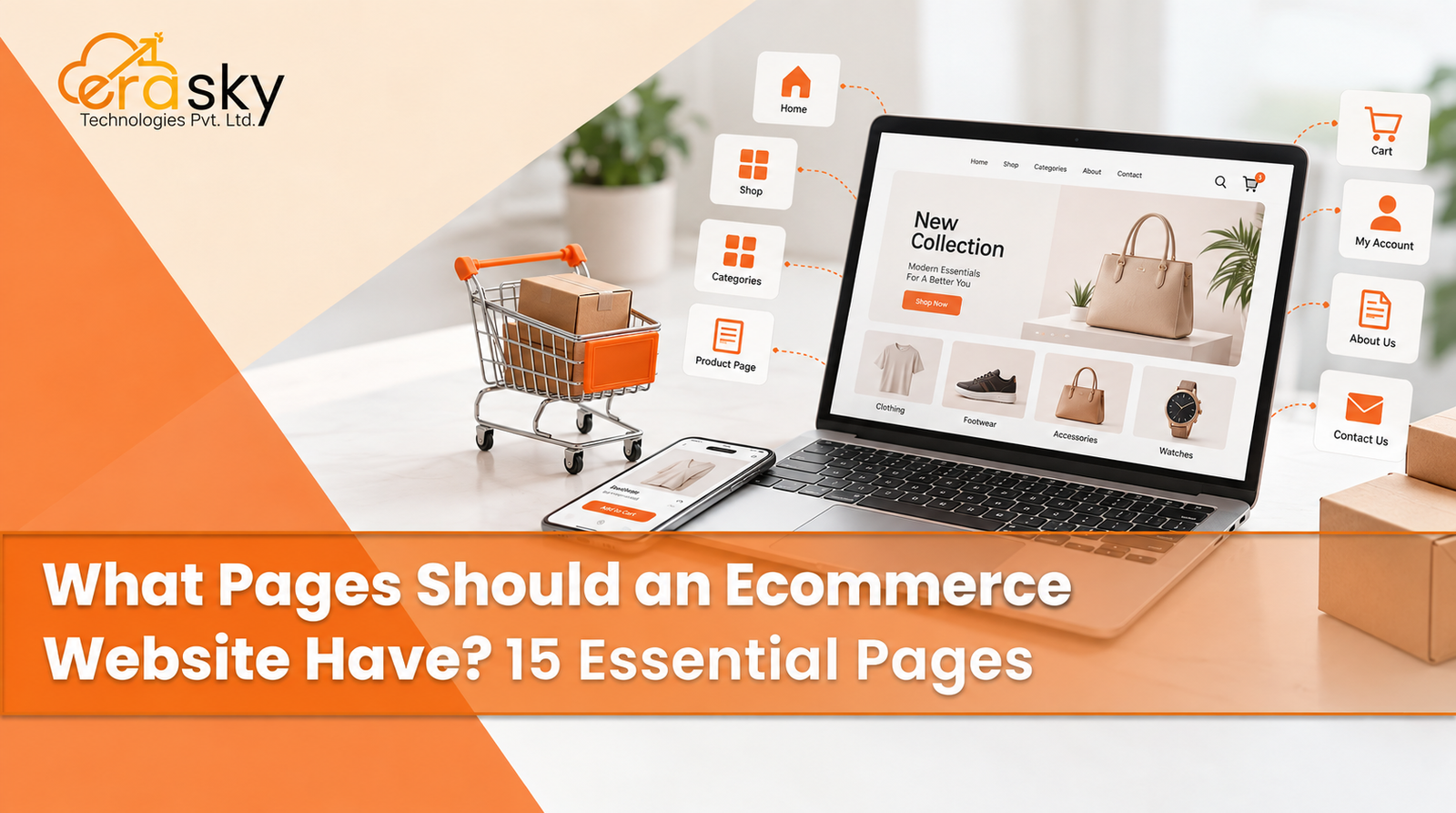
A strong ecommerce website needs more than product pages and a checkout button. Customers need clear ways to discover products, understand what they are buying, complete a purchase, get support, and know what happens after they pay.
For most online stores, essential ecommerce website pages fall into five jobs: product discovery, product information, purchasing, trust and support, and legal or account management.
The 15 essential ecommerce pages are:
- Homepage
- Shop or All Products Page
- Category Pages
- Product Detail Pages
- Search Results Page
- Shopping Cart Page
- Checkout Page
- About Us Page
- Contact Us Page
- FAQ Page
- Shipping Information Page
- Returns and Refund Policy Page
- Privacy Policy Page
- Terms and Conditions Page
- Account, Login, and Order Tracking Pages
These do not have to be 15 completely separate URLs. What matters is that each important customer need has a clear, accessible place.
15 Essential Ecommerce Website Pages
1. Homepage
Your homepage should quickly answer: What do you sell? Who is it for? Why should I explore?
Use clear navigation, key categories, important products or collections, trust signals, and strong paths into shopping. Avoid trying to show everything.
The homepage also helps establish the site's overall topic and connects visitors to important sections through internal links.
2. Shop or All Products Page
A Shop page gives customers a broad view of the catalog.
For larger stores, useful filtering, sorting, product cards, availability, and clear pagination or loading patterns make discovery easier. The goal is to help shoppers narrow their choices rather than open products one by one.
It can also support a clean ecommerce website structure by connecting naturally to categories and products.
3. Category Pages
Category pages organize products around a genuine shopping need, such as "running shoes" or "home office furniture."
A useful category page combines product listings with understandable navigation and relevant filters. When a category matches real search intent, it can also become an important SEO landing page.
Google recommends logical site organization and clear internal links so users and search engines can understand relationships between pages.
4. Product Detail Pages
This is where browsing becomes a buying decision.
A strong product page answers the questions that can stop someone from purchasing: What is it? What does it cost? What options exist? Is it available? When will it arrive? Can it be returned?
Include clear images, product details, price, availability, genuine reviews where applicable, shipping information, returns, and an obvious purchase action.
Relevant product structured data can help search engines understand visible product information when implemented correctly.
5. Search Results Page
Site search becomes increasingly important as a catalog grows.
Customers should be able to find products using common terms and variations. Useful filters, sensible relevance, spelling handling, and helpful no-result suggestions can prevent dead ends.
A failed search should guide the shopper toward related categories, popular products, or support rather than simply displaying "no results."
6. Shopping Cart Page
The cart is the customer's final review before checkout.
Show selected products, quantities, prices, available discounts, and relevant delivery or tax information as clearly as possible. Let shoppers edit quantities, remove items, continue shopping, or proceed to checkout.
The principle is simple: reduce uncertainty and avoid unpleasant surprises late in the journey.
7. Checkout Page
Checkout should be focused and easy to complete, especially on mobile.
Use clear field labels, understandable error messages, appropriate payment methods, and only the information needed for the transaction. Guest checkout may be useful for stores where creating an account is not necessary.
Payment and cardholder-data handling should use appropriate security controls and qualified payment providers. Businesses handling card payments also need to understand applicable PCI DSS obligations.
8. About Us Page
An About Us page should build understanding, not fill space.
Explain who operates the business, what it does, what it stands for, and any genuine experience or differentiators relevant to customers.
Specific facts are more convincing than exaggerated claims. For newer or less familiar ecommerce brands, this page can help answer the basic question: "Who am I buying from?"
9. Contact Us Page
Customers need a clear path to help before and after a purchase.
Depending on the business, provide email, phone, support hours, contact forms, live chat, or other support options. Include a physical address where appropriate.
A difficult-to-find contact option can create unnecessary hesitation, particularly for higher-value purchases.
10. FAQ Page
A strong FAQ answers real recurring questions about products, sizing, payments, shipping, cancellations, returns, order problems, and account issues.
Keep answers direct and useful. Do not turn the page into a keyword dump.
Important answers should still appear on the relevant product, shipping, returns, or checkout pages when customers need them there.
11. Shipping Information Page
Shipping can directly affect the purchase decision.
Explain where you ship, delivery options, processing times, estimated delivery windows, costs, restrictions, and what happens when an order is delayed or cannot be delivered.
Be precise about estimates. Do not describe an estimated delivery window as a guarantee unless it genuinely is one.
12. Returns and Refund Policy Page
Shoppers want to know what happens if a product is unsuitable, damaged, or no longer wanted.
Explain eligibility, deadlines, product-condition requirements, return steps, refunds, exchanges, damaged goods, and important exclusions.
Legal requirements can differ by country and state, so the policy should reflect the store's actual operations and applicable rules. The U.S. Federal Trade Commission provides business guidance on consumer protection.
13. Privacy Policy Page
An ecommerce business may collect names, email addresses, shipping information, account details, and order data.
A privacy policy should explain how personal information is collected, used, shared, stored, and managed.
Privacy obligations vary by jurisdiction and business activities. A generic policy copied from another store may not fit your actual practices.
14. Terms and Conditions Page
Terms and Conditions set the rules for website use and, where applicable, purchases.
They may address orders, pricing, accounts, acceptable use, intellectual property, disputes, and other conditions relevant to the business.
Because these terms can have legal consequences, use terms suited to the actual business rather than copying a competitor's page.
15. Account, Login, and Order Tracking Pages
Customers often need access to information after checkout.
Depending on the store, account functionality can provide login, password recovery, order history, saved addresses, invoices, returns, wishlists, and order tracking.
Not every shopper needs an account before buying. Guest checkout can reduce friction, while optional accounts can improve post-purchase convenience.
How Should an Ecommerce Website Be Structured?
Think of the site as a customer journey rather than a pile of pages.
A simple structure is:
Homepage → Category → Product → Cart → Checkout
Supporting pages sit around that journey:
About → Contact → FAQ → Shipping → Returns → Privacy → Terms
Search, filters, account tools, and order tracking support the journey without competing with it.
Important pages should be reachable through logical navigation and meaningful internal links. Avoid burying key products or categories without a clear reason.
Which Ecommerce Pages Matter Most for SEO and Conversions?
Product and category pages usually carry much of the commercial weight because they help customers discover and evaluate products. Cart and checkout support the transaction. Shipping, returns, FAQs, and contact information reduce uncertainty.
That is why SEO and conversion work should not be treated as separate projects.
A well-optimized product page cannot fix confusing navigation. More blog content cannot compensate for a checkout that is difficult to use. A beautiful homepage cannot rescue product pages that fail to answer basic buying questions.
The best ecommerce website structure connects search visibility with an understandable customer journey.
Common Ecommerce Website Structure Mistakes
Common problems include unclear navigation, thin product pages, hidden shipping and return information, difficult checkout forms, weak mobile layouts, poor site search, copied policy pages, and important pages with weak internal links.
Another mistake is assuming that more pages automatically create a better ecommerce site.
They do not.
The objective is to give every important customer question, action, and decision a clear home.
Build an Ecommerce Website With the Right Structure
As an ecommerce business grows, its website becomes harder to restructure. New products create new product pages; product lines create categories; marketing adds landing pages; and integrations introduce new technical requirements.
That makes information architecture an early business decision, not merely a design detail.
Era Sky Technologies approaches website development around UI and UX planning, responsive layouts, backend development, API integration, CMS setup, technical SEO, performance optimization, and scalable architecture. Its stated process follows analysis, planning, execution, optimization, and scaling.
For an ecommerce project, the practical goal is to make navigation, content hierarchy, mobile experience, technical performance, integrations, SEO, and checkout work together.
Turn Your Ecommerce Structure Into a Better Customer Journey
The right ecommerce pages should help a visitor move from discovery to confidence to purchase, then make post-purchase support easy.
Before development begins, map what the customer needs to know or do at every stage. Give each important need a clear page or feature, connect related pages logically, and make the experience work across mobile and desktop.
Era Sky Technologies can support businesses that need ecommerce website development with a focus on structured planning, technical implementation, performance, and scalable website architecture.
The best question is not "How many pages should my ecommerce website have?"
It is "What does my customer need at each stage of the buying journey, and where should that need be answered?"
That answer gives you a website structure built around people first.
Frequently Asked Questions
1. What pages should every ecommerce website have?
Most stores need a homepage, shop or listing page, category pages, product pages, cart, checkout, contact information, shipping details, returns and refunds, privacy, and terms. FAQ, About, search, account, and order tracking functionality may also be important depending on the business.
2. How many pages should an ecommerce website have?
There is no universal page count. A small store may have a compact structure, while a large catalog may contain hundreds or thousands of product and category pages. The right structure depends on the catalog, audience, business model, and customer journey.
3. Are category pages important for ecommerce SEO?
They can be important when they match genuine product-discovery intent and provide useful navigation, filtering, and content. Their value comes from relevance and usefulness, not from creating large numbers of category URLs.
4. Does an ecommerce website need an About Us page?
An About Us page can help customers understand who operates the store and why it exists. It is especially useful for newer or less familiar brands, provided the information is specific and genuine.
5. What legal pages does an ecommerce website need?
Privacy, terms, shipping, and returns information are common ecommerce requirements, but exact obligations vary by jurisdiction, business model, products, and data practices. Businesses should review their policies against the rules that apply to them.
6. Should an ecommerce website have a separate FAQ page?
A dedicated FAQ can be useful for recurring questions about products, shipping, payments, returns, and orders. However, important information should also be placed directly on the page where the customer needs it.
7. How do ecommerce website pages improve conversions?
They reduce friction and uncertainty. Product pages support evaluation, categories improve discovery, checkout enables purchase, and support and policy pages answer concerns that may otherwise prevent a customer from buying.