Recent Posts
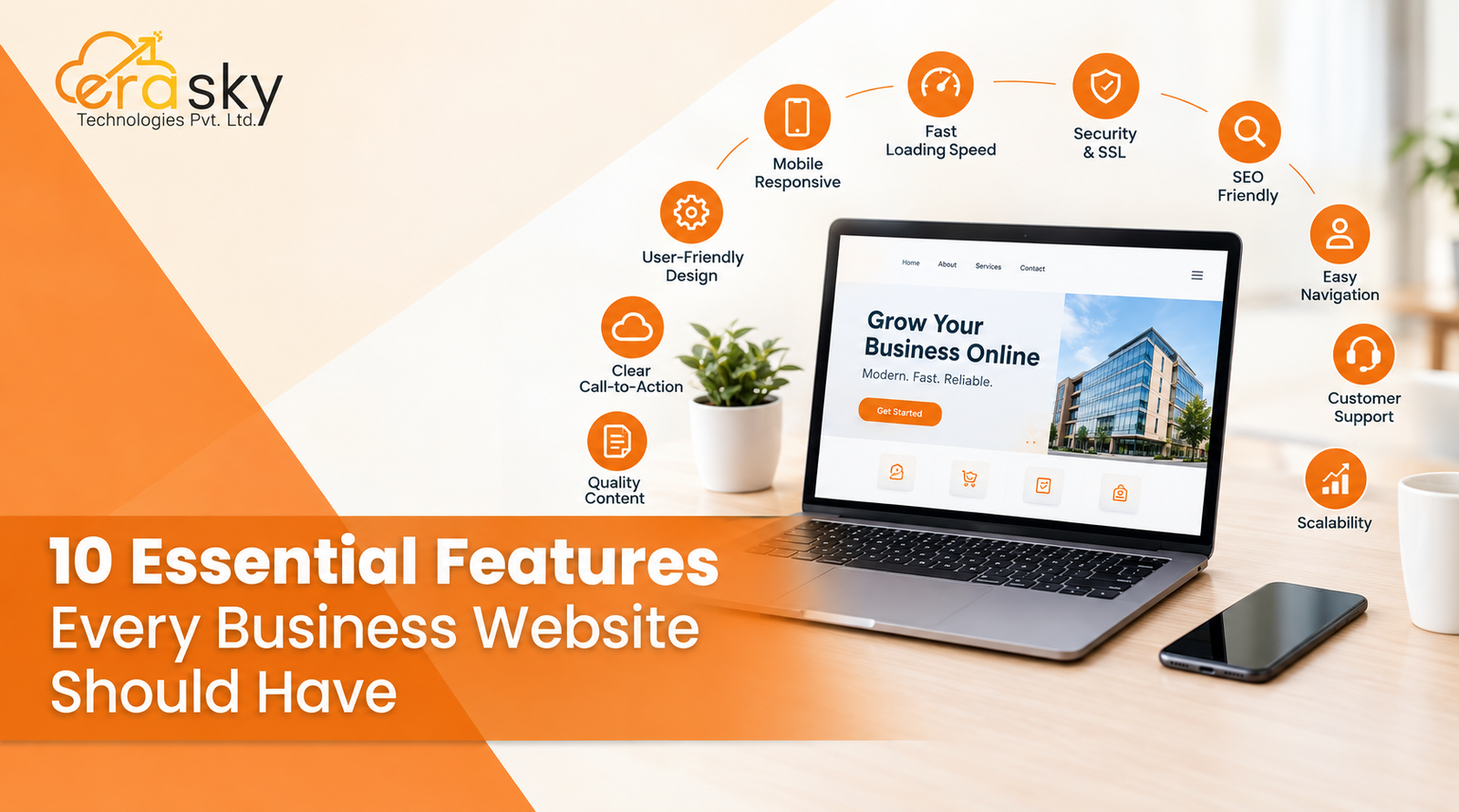
A business website should do more than put a company online. It should help the right visitor understand what the business offers, feel confident about it, and take the next step. The essential features are straightforward: mobile responsiveness, fast loading, clear navigation, strong calls to action, easy contact options, security, SEO-friendly structure, trust signals, useful content, and analytics.
Together, these features support a simple business journey:
visibility → understanding → trust → engagement → lead → conversion
Here is what each feature should do.
1. Mobile-Responsive Design
A modern business website needs to work comfortably on phones, tablets, and desktops. Responsive design adapts the layout to the visitor's screen. Text should remain readable, buttons should be easy to tap, images should fit properly, and menus should work without awkward zooming or sideways scrolling. This matters because customers may discover a company while searching from a phone, comparing providers, checking services, or trying to contact the business. A poor mobile experience can create friction at the exact moment someone is ready to act.
Accessibility should be considered at the same stage. Content, controls, contrast, labels, and navigation should be usable by people with different abilities and methods of interaction. The Web Content Accessibility Guidelines (WCAG) provide a recognized framework for accessible web content.
At minimum, test whether visitors can read pages, navigate menus, complete forms, and reach key contact options easily on smaller screens.
2. Fast Loading Speed
People rarely wait patiently for a business website to become usable. Large images, unnecessary scripts, inefficient code, excessive plugins, and weak hosting can slow pages down. Performance should therefore be treated as a business feature, not only a developer concern. Google's published Core Web Vitals guidance evaluates loading, responsiveness, and visual stability. Its commonly used "good" thresholds include an LCP of 2.5 seconds or less, an INP of 200 milliseconds or less, and a CLS of 0.1 or less at the 75th percentile.
Businesses can improve performance by compressing images, reducing unnecessary scripts, using efficient caching, improving server response time, and removing features that add little value. The practical goal is simple: visitors should be able to get useful information quickly.
3. Clear, Intuitive Navigation
Visitors should not have to figure out how a company organizes its website.
A clear navigation system makes core information easy to find. Depending on the business, that may include Services, Products, About, Contact, Pricing, FAQs, or location pages.
Good navigation is:
- Easy to scan
- Consistent across pages
- Organized around visitor needs
- Clear enough to understand immediately
Information architecture matters too. Someone arriving on a service page should be able to understand where they are, what the business provides, and where to go next. Good navigation reduces friction and keeps the customer journey moving.
4. Clear Calls to Action
A website can attract visitors and still generate few leads if it never clearly explains what to do next. A call to action, or CTA, prompts a specific action such as Request a Quote, Book a Consultation, Schedule an Appointment, Call Now, or Get Started.
The right CTA depends on the business and the visitor's stage of research. A person comparing solutions may need more information before they are ready to request a quote. Effective CTAs are specific, noticeable, relevant to the page, and easy to complete. Avoid repeating "Contact Us" without explaining the value of taking that step. A conversion-focused website makes the desired next action obvious without being pushy.
5. Easy Contact and Lead-Capture Options
When a visitor decides to reach out, the path should be obvious. Depending on the business model, useful options can include contact forms, phone numbers, email, online booking, live chat, or another appropriate contact channel. Forms should ask for the information the business actually needs. A simple inquiry should not require a long application.
A good lead-capture experience also makes expectations clear: what information to provide, what happens after submission, and how the business will respond. A lead-generation website is not merely a website with a form. It is a website designed to make the transition from interest to inquiry easy.
6. Security and HTTPS
Security is a basic requirement for a professional business website, especially when visitors submit personal information. HTTPS encrypts data exchanged between a browser and a website. An SSL certificate supports HTTPS, but website security involves more than installing a certificate and leaving everything else untouched.
Businesses should also consider secure hosting, CMS and plugin updates, strong administrator authentication, spam protection, backups, recovery procedures, and responsible handling of customer data. Security also affects trust. Browser warnings, broken forms, outdated software, or other visible technical problems can make visitors hesitate before sharing information.
7. An SEO-Friendly Structure
Search engine optimization should be part of website planning, not an afterthought. An SEO-friendly business website has a logical structure that helps search engines discover and understand important pages while also helping visitors find them.
Important foundations can include descriptive titles and headings, crawlable internal links, clear URLs, useful page content, mobile-friendly implementation, relevant image alternative text, appropriate indexing controls, and XML sitemaps. Google's Search Essentials and SEO documentation provide guidance on these fundamentals.
Structured data can also be useful when it accurately describes visible page content. For local businesses, consistent business information and a properly managed Google Business Profile can support local search visibility.
SEO does not replace good UX. The strongest business websites connect technical SEO with useful content and a clear customer journey.
8. Trust Signals and Credibility
Before contacting a company, visitors often want evidence that it is legitimate and capable. Trust signals can include genuine customer reviews, testimonials, professional branding, clear business information, relevant credentials, case studies with verifiable details, and transparent descriptions of services.
Specific evidence is usually more useful than vague praise. A testimonial that explains what the customer valued can tell a prospective buyer more than a generic statement about being "the best." Businesses should also avoid unsupported claims such as guaranteed rankings, guaranteed leads, or guaranteed revenue. Trust grows when the website communicates clearly about both capabilities and limitations.
9. Useful, Relevant Content
A business website needs useful information, not just attractive pages.
Visitors should quickly understand:
- What the business offers
- Who it serves
- What problem it solves
- Why the offering may be relevant
- What the next step is
Depending on the business, valuable content may include service pages, product details, FAQs, pricing guidance, case studies, process explanations, comparison content, or location-specific information. This helps with both SEO and conversion. Search engines can better understand what the business covers, while customers get the information they need to make a decision.
The objective is not publishing the most content. It is answering the questions that matter before a customer reaches out.
10. Analytics and Performance Tracking
A website should not become a black box after launch. Analytics help businesses understand where visitors come from, what pages they view, where they leave, and which actions contribute to leads or sales.
Common tools include Google Analytics 4 and Google Search Console. Depending on the business, tracking may also include CRM systems, call tracking, advertising platforms, or form analytics.
Track meaningful actions such as:
- Form submissions
- Phone clicks
- Quote requests
- Appointment bookings
- Purchases
- Key service-page visits
- Organic search performance
The important part is what happens after measurement. If a page receives traffic but few inquiries, the business can investigate its message, offer, CTA, page experience, or traffic quality and make informed changes. Measurement turns a website into something that can be improved instead of a digital brochure that simply sits online.
How These Features Work Together
The 10 features above are connected. Responsive design makes the site usable. Speed reduces friction. Navigation helps people find answers. Content builds understanding. Trust signals reduce uncertainty. SEO supports discovery. CTAs and contact options make action easier. Security protects the interaction. Analytics reveal what is working and what needs improvement.
That is why a beautiful website can still struggle to generate business. For example, a site may have strong visuals and excellent search visibility, but vague service pages and a complicated contact form can still cost it leads. Another site may load quickly but provide no clear reason for visitors to take action.
The goal is not to collect features. The goal is to remove obstacles between a potential customer and a useful next step.
When a Business Needs More Than a Template
Website builders and templates can work well for some businesses, especially when the requirements are simple. More complex businesses may need custom functionality, e-commerce workflows, third-party integrations, advanced SEO structures, online booking, multiple service areas, or an architecture designed to scale.
In those situations, development decisions matter as much as visual design. UI and UX planning, responsive layouts, backend development, API integration, CMS setup, technical SEO, performance optimization, security, and scalability all need to work together.
Era Sky Technologies, established in 2022, provides website development that includes these areas. The company's stated approach is to understand the business requirement, plan the solution, execute it, optimize performance, and build with future growth in mind.
A Practical Pre-Launch Check
Before launching or redesigning a business website, review it as a first-time customer. Can you understand the offer quickly? Does the site work well on a phone? Can you find the main services without effort? Is the next action obvious? Do contact forms work? Is HTTPS active? Are business details and testimonials genuine? Are important pages technically accessible to search engines? Can the team measure leads and other meaningful actions? A website is ready when it is not only visually complete, but useful, trustworthy, functional, and measurable.
Frequently Asked Questions
What features should every business website have?
Most business websites need mobile responsiveness, fast performance, clear navigation, strong CTAs, easy contact options, HTTPS security, an SEO-friendly structure, trust signals, useful content, and analytics.
How fast should a business website load?
There is no single loading time that guarantees good results. Performance depends on the page, device, connection, and user experience. Core Web Vitals provide useful benchmarks, but businesses should monitor real-world performance rather than rely on one speed-test score.
What makes a business website trustworthy?
Genuine reviews, clear business information, professional branding, transparent service details, secure HTTPS connections, credible credentials, and accurate contact information can all strengthen trust.
How can a website generate more leads?
Make the value proposition clear, create useful service or product pages, use relevant CTAs, keep forms simple, and remove unnecessary friction from the inquiry process. Tracking then helps identify where visitors are dropping out.
Why is mobile responsiveness important?
Responsive websites adapt content and controls to different screen sizes, making pages easier to read and actions easier to complete. This is especially important for visitors using smartphones.
Does every business need SEO?
Businesses that want to attract customers through organic search can often benefit from SEO. The right strategy depends on the business model, audience, competition, market, and geographic focus. SEO should support a technically sound website and genuinely useful content.
Should a business website include customer reviews?
Genuine reviews and testimonials can reduce uncertainty and provide social proof. They are most useful when specific, relevant, and presented honestly.
Build a Website That Works for the Business
A professional business website should help people find the company, understand its offer, trust the business, and take the next appropriate step. That makes website development more than a design exercise. Performance, UX, content, SEO, security, accessibility, and lead generation should support the same customer journey.
For a business planning a new website or redesign, the first question should not be "Which template looks best?" It should be "What does this website need to accomplish, and what is currently getting in the way?" That question leads to better decisions, clearer priorities, and a website built to serve the business rather than simply occupy a URL.