Recent Posts
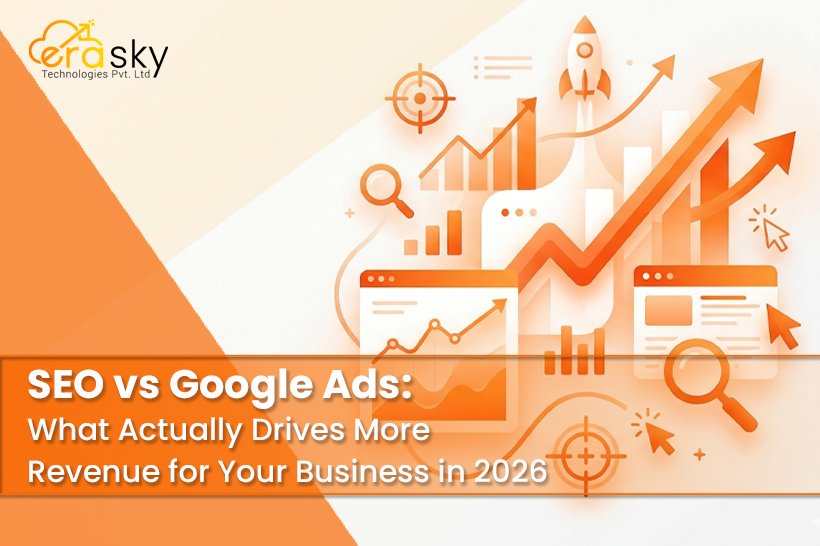
1. The Digital Marketing Dilemma in 2026
Every business owner faces the same question at some point: Should I invest in SEO or just run Google Ads?
It sounds simple, but the answer can make or break your marketing budget. In 2026, as ad costs rise, algorithms become more sophisticated, and competition intensifies, making this decision crucial.
Both SEO and Google Ads can drive revenue. But which one is right for your business depends on your goals, timeline, and budget, and that's exactly what this guide breaks down.
At Era Sky Technologies, we've helped hundreds of businesses navigate this choice. Here's everything you need to know.
2. What is SEO?
Search Engine Optimization (SEO) is the process of optimizing your website so it ranks higher on Google and other search engines organically, without paying for each click.
When someone searches for "best digital marketing agency in Delhi" and your website shows up on page one, that's SEO at work.
Key components of SEO include:
On-Page SEO — Optimizing your content, headings, keywords, and meta tags so Google understands what your page is about.
Technical SEO — Improving your website's speed, mobile-friendliness, site structure, and crawlability.
Off-Page SEO — Building backlinks from other reputable websites to increase your domain authority.
Why businesses love SEO:
- Drives long-term, sustainable traffic
- Builds brand credibility and trust
- Compounds over time - the longer you invest, the more you gain
- Lower cost per acquisition over the long run
3. What is Google Ads?
Google Ads (formerly Google AdWords) is a paid advertising platform where you bid to show your ads at the top of Google search results, on YouTube, or across millions of websites in the Google Display Network.
Every time someone clicks your ad, you pay — which is why it's called Pay-Per-Click (PPC) marketing. Understanding PPC vs. SEO is essential before deciding where to invest your budget.
Types of Google Ads:
Search Ads — Text ads that appear at the top of Google search results.
Display Ads — Visual banner ads that appear across websites in Google's network—a core form of online advertising.
Shopping Ads — Product listing ads ideal for e-commerce businesses.
Why businesses love Google Ads:
- Instant visibility from day one
- Highly targeted — reach specific demographics, locations, and intent
- Fully scalable — increase budget to increase reach
- Measurable ROI with detailed analytics and conversion optimization
4. SEO vs Google Ads: Core Differences
The two channels differ across nearly every dimension that matters to a business owner.
Speed: Ads go live within hours. SEO takes 3–6 months to show meaningful results.
Cost: Ads charge per click — costs never stop. SEO demands upfront investment, but traffic becomes essentially free once you rank.
Sustainability: A ranked page can drive traffic for years. Pause your ad budget, and traffic vanishes overnight.
Trust: Users trust organic results more. Google's "Sponsored" label causes many to skip paid listings entirely.
Traffic Quality: Both attract high-intent visitors, but organic users tend to engage more, stay longer, and convert better over time.
The fundamental difference is this: SEO builds an asset. Google Ads rents traffic.
5. Cost Comparison: Which is More Profitable in 2026?
Most businesses tend to become confused here, so let's clarify the actual costs of each option.
SEO Costs: SEO requires an upfront investment in content creation, technical optimization, and link building. You might spend ₹20,000–₹80,000/month on a good SEO agency. But here's the magic: once you rank, traffic is essentially free. Your ROI compounds month over month.
Google Ads Costs: You pay for every single click. In competitive industries, a single click can cost ₹50–₹500 or more. Your traffic vanishes overnight if you put your budget on hold. There's no residual value.
Long-Term ROI Example:
A business spending ₹50,000/month on SEO for 12 months may rank for dozens of high-value keywords and receive thousands of free visitors monthly — indefinitely. A business spending ₹50,000/month on online advertising via Google Ads receives traffic only for as long as the budget flows.
The verdict? SEO offers a higher long-term ROI. Google Ads offers a faster short-term return.
6. Traffic & Conversion Comparison
SEO Traffic: People who find your site organically are often deep in the research or decision-making phase. They searched for something specific, found you naturally, and are more likely to trust your brand. This condition tends to lead to higher engagement, lower bounce rates, and better long-term conversion optimization.
Google Ads Traffic: Paid traffic can be extremely high-intent, especially for bottom-of-funnel keywords like "buy now" or "best price." However, conversion rates depend heavily on how well your ads and landing pages are optimized. Without a proper setup, you risk quickly depleting your budget with minimal results.
Understanding the difference between organic vs paid traffic is key to knowing which channel aligns with your business model. Overall, SEO tends to win on conversion quality over time, while Google Ads wins on speed and scalability when campaigns are managed well.
7. When Should You Choose SEO?
SEO is the right choice when:
- You're building a business for the long term and want sustainable traffic
- You want to establish your brand as an authority in your industry
- Your budget is limited and you want a channel that grows in value over time
- You're in an industry where content and education drive purchases (e.g., SaaS, healthcare, legal, consulting)
- You want to reduce your dependence on paid online advertising
Ideal for: Startups, small businesses, content-driven brands, local service businesses, and companies targeting informational or research-based searches.
8. When Should You Choose Google Ads?
Google Ads is the right choice when:
- You need lead generation immediately — for a product launch, seasonal promotion, or new market entry
- You're in a highly competitive space and need instant visibility while your SEO grows
- You have a tested offer and want to scale it fast
- You're an e-commerce brand running shopping campaigns
- You have the budget to sustain ongoing ad spend and a team (or agency) to manage conversion optimization
Ideal for: E-commerce stores, service businesses with high customer lifetime value, B2B lead generation, and any business launching a new product or entering a new market.
9. The Hybrid Strategy: Why Smart Businesses Use Both
The smartest businesses don’t choose between SEO and Google Ads, they combine both into a unified strategy.
How it works:
- Short-term (0–6 months): Use Google Ads for immediate leads while building your SEO foundation.
- Medium-term (6–12 months): As SEO gains traction, reduce ad spend on keywords you rank for organically.
- Long-term (12+ months): SEO drives most traffic, while ads support competitive keywords, retargeting, and seasonal campaigns.
Key advantage: Data from ads (high-converting keywords, messaging, audience insights) strengthens your SEO strategy.
At Era Sky Technologies, we integrate both channels to maximize ROI at every growth stage.
10. How SEO Has Evolved: Beyond Traditional Search
SEO in 2026 goes far beyond ranking on traditional search results. With the rise of AI-driven platforms, businesses must optimize for how users actually find answers today.
Key Evolutions:
AEO (Answer Engine Optimization)
Focuses on structuring content to appear as direct answers in search engines and voice assistants. This includes clear Q&A formats, FAQs, and structured data—helping your content become the answer, not just a result.
GEO (Generative Engine Optimization)
Targets AI platforms like ChatGPT and Google Gemini. The goal is to create authoritative, well-researched content that AI tools reference in generated responses.
AIO (AI Overview Optimization)
Optimizes content for Google’s AI-generated summaries at the top of search results. Success here requires comprehensive, high-quality content that fully satisfies user intent.
Why It Matters
Search is no longer limited to Google results pages—it spans voice assistants and AI tools. A modern SEO strategy must ensure your brand appears across all these touchpoints.
At Era Sky Technologies, SEO strategies are designed to capture visibility across search, voice, and AI platforms—not just rankings.
11. Trends in 2026: What's Changing?
The digital marketing landscape is shifting fast. Here's what's impacting both SEO and Google Ads in 2026:
AI-Driven Search: Google's AI Overviews and generative search features are reshaping how users find information. SEO now requires a stronger focus on E-E-A-T (Experience, Expertise, Authoritativeness, Trustworthiness) — and an understanding of AEO, GEO, and AIO as discussed above.
Rising Ad Costs: CPC (cost per click) continues to climb across most industries, making conversion optimization more important than ever — you can't afford to optimize for clicks alone.
Voice and Mobile Search: More searches are happening on mobile and via voice assistants — demanding faster, cleaner, more conversational content optimized for AEO.
User Experience as a Ranking Factor: Google increasingly rewards websites that offer fast load times, intuitive navigation, and genuinely helpful content.
First-Party Data: As third-party cookies phase out, businesses that build their own audience data will have a significant advantage in both organic vs paid traffic strategies.
12. Common Mistakes Businesses Make
- Relying on one channel: Depending only on SEO or ads is risky. Algorithm changes or budget cuts can quickly impact results. Diversification is key.
- Expecting instant SEO results: SEO takes time—typically 3–6 months to gain traction and over 12 months to fully scale.
- Ignoring the new search landscape: Focusing only on traditional SEO while neglecting AEO, GEO, and AIO leads to lost visibility in AI and voice search.
- Poor ad targeting: Ineffective keyword selection and lack of audience targeting in Google Ads can waste budget without generating quality leads.
- Ignoring analytics: Without tracking and optimizing performance data, businesses miss opportunities to improve ROI and conversions.
- Treating SEO and Ads separately: SEO and PPC should work together. The best strategies combine insights from both for better results.
13. SEO vs Google Ads: Which is Better for Your Business?
There’s no one-size-fits-all answer—it depends on your goals:
- Budget: SEO is more cost-effective long-term, while a flexible budget allows you to run both SEO and Google Ads together.
- Timeline: Need results fast? Google Ads works within days. For sustained growth, SEO is the better investment.
- Competition: In competitive industries, combining both channels delivers better results.
- Business goals: SEO builds long-term authority; Google Ads drives immediate leads and sales.
Quick Comparison
- Best for: SEO → long-term growth | Google Ads → instant results
- Cost over time: SEO decreases | Ads remain ongoing
- Traffic after stopping: SEO continues | Ads stop instantly
- Trust: Organic traffic is more trusted | Ads are less trusted
- Timeline: SEO (6–18 months) | Ads (days–weeks)
- Scalability: Ads scale fast | SEO compounds over time
For maximum revenue, most businesses benefit from using both strategically.
14. How Era Sky Technologies Can Help
At Era Sky Technologies, we build result-driven digital marketing strategies tailored to your business.
- SEO Services: End-to-end SEO covering technical optimization, content, and growth across search, AEO, GEO, and AIO
- Google Ads Management: ROI-focused PPC campaigns to drive leads and reduce wasted spend
- Integrated Strategy: A balanced approach combining organic and paid channels for maximum impact
Whether you're starting out or scaling, we create strategies aligned with your goals.
Ready to grow? Book a free consultation today.
15. Conclusion
The SEO vs. Google Ads debate doesn't have a winner — it has a context.
If you need traffic today, Google Ads delivers. If you want to build a digital asset that generates leads for years without paying per click, SEO is your foundation. And with search evolving rapidly through AEO, GEO, and AIO, investing in the right SEO strategy today means staying visible not just on Google but across every platform where your audience is asking questions.
A smart digital marketing strategy that combines both paid and organic and embraces the future of AI-driven search is almost always the answer for businesses serious about growth in 2026 and beyond.
Don't let indecision cost you growth. Evaluate your goals, your budget, and your timeline, then build a strategy that serves all three.
16. FAQs
1. Is SEO better than Google Ads in 2026?
Neither is universally better. SEO is ideal for long-term growth, while Google Ads delivers quick results. Most businesses benefit from using both.
2. Which is cheaper: SEO or Google Ads?
SEO becomes more cost-effective over time, while Google Ads requires continuous spending.
3. What are AEO, GEO, and AIO?
They are modern SEO approaches:
- AEO: Optimizing for direct answers
- GEO: Optimizing for AI-generated platforms like ChatGPT
- AIO: Optimizing for Google’s AI summaries
4. Can I use both SEO and Google Ads together?
Yes, combining both drives better results and smarter strategy.
5. How long does SEO take?
Typically 3–6 months for initial results, 9–18 months for strong growth.
6. What is a good starting budget for Google Ads?
Around ₹15,000–₹30,000/month, depending on competition and goals.