Recent Posts
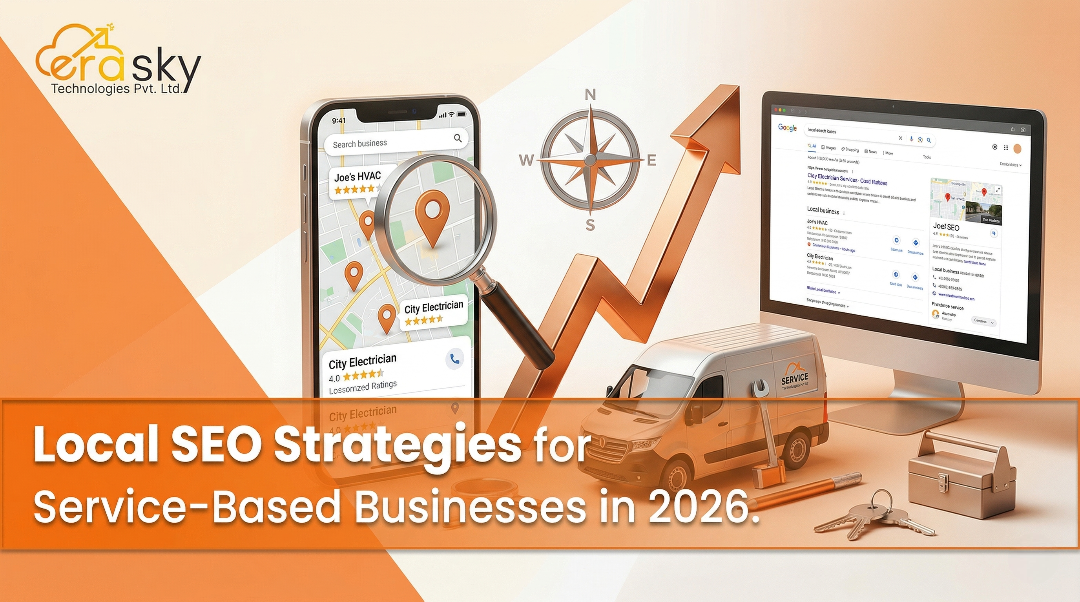
Introduction: Local SEO Isn’t About Rankings Anymore—It’s About Revenue
Search for something as simple as “electrician near me” today and notice what shows up. You don’t just see websites anymore. You see maps, reviews, business hours, photos, AI-generated summaries, and quick action buttons like call or directions. Traditional blue links are no longer the main event.
This shift reflects how people actually search now.
Around 46% of Google searches carry local intent. “Near me” searches have grown by nearly 900% over the past few years. More importantly, 76% of mobile local searches result in a visit within 24 hours, and 28% of those visits convert into a purchase or service.
That changes everything.
Local SEO is no longer about traffic. It is about visibility at the moment of decision. It has quietly become one of the most direct revenue channels available to service-based businesses.
This guide breaks down modern local seo strategies using a practical, experience-driven lens. You will see what actually works today, how AI is reshaping local search, and how businesses can turn visibility into measurable growth.
The Reality of Local Search in 2026: What Changed (and Why It Matters)
Search Is Now a Multi-Surface Ecosystem
Search is no longer limited to Google rankings. Your potential customer might find you through:
- Google Maps and the Map Pack
- AI-generated answers
- Voice assistants
- Visual search tools like Google Lens
- Social platforms and video content
This shift has redefined local search visibility. Being ranked number one on a website result is no longer enough. You need an omnichannel search presence.
Visibility now means showing up wherever your customer is looking, not just where you expect them to look.
From SEO to AEO + GEO (The Quiet Shift Most Businesses Miss)
Traditional SEO is being reshaped by AI. Users are increasingly getting answers directly from search engines instead of clicking through to websites.
This has led to the rise of:
- Answer Engine Optimization
- Generative Engine Optimization
For example, a blog that once ranked well might now receive fewer clicks because the answer appears directly in search results.
The implication is clear.
Content must now:
- Answer questions directly
- Be structured for extraction
- Provide meaningful context
Surface-level content is getting ignored. Depth wins.
The Opportunity Gap (Most Businesses Are Still Behind)
Here’s where things get interesting.
About 58% of businesses still do not properly invest in local seo for small business, and only 30% follow a structured strategy. Meanwhile, 94% of top-performing local brands actively optimize their presence.
This is not a crowded space. It is an underutilized one.
For service-based businesses, that gap represents a serious growth opportunity.
Core Ranking Factors in Local SEO (What Actually Moves the Needle Now)
The New Ranking Model: Interconnected Signals
Google now evaluates a combination of signals instead of relying on one factor:
- google business profile optimization
- Review quality and recency
- Engagement signals
- Service relevance
- Local content strength
- Citation consistency
- Website experience and intent match
These elements do not work in isolation. They reinforce each other.
Behavioral Signals: The Hidden Ranking Lever
User behavior is now a ranking factor.
Google tracks:
- Click-to-call actions
- Direction requests
- Time spent on listings
- Photo interactions
If users engage with your listing, your rankings improve. If they ignore it, your visibility declines.
A business with fewer backlinks but stronger engagement often outranks competitors. That is the new reality.
Local SEO Strategy Framework for 2026 (Step-by-Step Execution)
Phase 1: Foundation (Where Most Businesses Either Win or Fail Early)
Google Business Profile Optimization (Non-Negotiable Core)
Your Google Business Profile is the center of your local presence.
Key elements include:
- Correct primary category
- Fully completed profile
- Accurate business information
- Updated hours
- Services and descriptions
Businesses with complete profiles gain 2.7 times more trust and generate up to 70% more visits.
Even small improvements, like adding service descriptions or uploading real photos, can increase calls significantly.
This is where most local business listing optimization efforts should begin.
Service-Level Page Architecture (Specificity Wins)
Generic service pages are no longer enough.
Instead, build:
- Individual service pages
- Location-specific pages
For example:
- /ac-repair-delhi
- /plumber-near-andheri
Google prefers specificity. The more precise your page is, the more relevant it becomes.
Technical Local SEO Essentials
Technical performance still matters.
Focus on:
- Mobile-first experience
- Load speed under 2.5 seconds
- Structured data like local schema markup
These factors support both rankings and user experience. Without them, even strong content struggles.
Phase 2: Authority and Trust Signals (Where Rankings Stabilize)
Review Strategy: The Most Powerful Ranking Factor
Reviews now carry contextual weight.
Google looks at:
- Keywords within reviews
- Location mentions
- Detailed experiences
A consistent flow of 2 to 4 reviews per month is more effective than bursts of activity.
Responding within 48 hours strengthens credibility and engagement.
Quality matters more than quantity.
Visual and Media Optimization (Underrated Growth Lever)
Visual content plays a bigger role than most businesses realize.
Upload:
- Real images of your work
- Team photos
- Short videos
This improves engagement and supports visual discovery through tools like Google Lens.
Citation and Entity Building
Your business needs to exist across the web.
This includes:
- Structured directories like Yelp and Justdial
- Unstructured mentions in blogs and media
AI models rely heavily on these signals to validate your credibility.
Phase 3: Content Strategy (AEO + GEO in Action)
Conversational Content Optimization
Search is becoming more conversational.
Users ask:
- “Best electrician near me open now”
- “Cost of AC repair in Delhi”
Content should reflect how people actually speak.
Rigid, keyword-heavy writing feels outdated. Natural language performs better.
Hyperlocal Content Strategy (Where Real Growth Happens)
Target micro-locations instead of broad cities.
Create:
- Area-specific pages
- Landmark-based content
- Local case studies
For example:
- “AC repair near Connaught Place”
- “Plumber near Andheri West”
Hyperlocal targeting is consistently outperforming broader strategies.
Intent-Layered Content Funnel
Cover every stage of the customer journey.
- Informational: “Why is my AC leaking?”
- Commercial: “AC repair cost in Bangalore”
- Transactional: “Best AC repair near me”
Businesses that align content with intent dominate conversions.
Phase 4: Engagement and Conversion Optimization
Optimize for Engagement Metrics
Focus on:
- Click-through rates
- Call actions
- Booking flows
If users do not take action, rankings eventually decline.
Messaging and Instant Response Systems
Speed matters.
Enable messaging and respond within minutes when possible. Faster responses increase both trust and conversion rates.
Google Posts and Updates Strategy
Use posts to share:
- Offers
- Updates
- Announcements
These improve visibility within your business listing.
Phase 5: AI and Future-Proofing Your Local SEO
Optimizing for AI Search (GEO Strategy)
AI-driven search is reducing traditional clicks by up to 40%.
To adapt:
- Provide structured answers
- Maintain factual clarity
- Build authority signals
Multi-Platform Visibility (Non-Negotiable Now)
Your presence should extend beyond Google.
Include:
- Maps
- YouTube
- Social platforms
- AI interfaces
Local SEO is now a multi-platform strategy.
Emerging Trends You Can’t Ignore in 2026
- Voice search is driving conversational queries
- Visual search is increasing discovery through images
- Hyperlocal targeting is outperforming city-level strategies
- Maps are evolving into recommendation engines
- Authenticity is becoming a ranking factor
Google is actively filtering out manipulation tactics.
Interesting Facts
- Listings with photos receive significantly more engagement
- Businesses that respond to reviews rank higher over time
- Hyperlocal pages convert better than general service pages
- AI-driven results prioritize structured content
- Engagement signals often outweigh backlinks in local rankings
What Doesn’t Work Anymore (And Can Hurt You)
Some tactics now actively reduce visibility:
- Keyword-stuffed business names
- Fake reviews
- Thin location pages
- Generic, low-value content
- Random backlink building
Shortcuts are no longer neutral. They are harmful.
KPIs That Actually Matter in Local SEO (Beyond Rankings)
Track what drives real results:
- Business profile impressions
- Calls generated
- Direction requests
- Review consistency
- Conversion rates
- Engagement metrics
Rankings alone do not tell the full story anymore.
90-Day Execution Blueprint (Practical Rollout Plan)
Month 1: Foundation
Audit your listing, fix inconsistencies, build core pages
Month 2: Trust Building
Generate reviews, add media, build citations
Month 3: Growth
Publish hyperlocal content, optimize conversions, build partnerships
Consistency always outperforms one-time effort.
Strategic Takeaways (What Actually Wins in 2026)
- Local SEO is a revenue channel, not just a traffic source
- Engagement signals directly influence rankings
- Reviews and trust drive long-term growth
- AI is reshaping how visibility works
- Hyperlocal and intent-driven content performs best
- Omnichannel presence is essential
FAQs
What is the most important local SEO strategy in 2026?
A combination of google business profile optimization, consistent reviews, and strong engagement signals.
How is local SEO different from traditional SEO now?
It focuses more on real-world interactions, AI visibility, and multi-platform presence.
How many reviews do I need to rank locally?
Consistency matters more than volume. Aim for 2 to 4 high-quality reviews monthly.
Does AI affect local SEO rankings?
Yes. AI reduces clicks and prioritizes structured, answer-focused content.
Is local SEO worth it for small businesses?
Absolutely. It directly impacts conversions and customer acquisition.
What are the best keywords for local SEO?
Core terms include local seo strategies, local seo for small business, and google business profile optimization, along with location-based queries.
Conclusion
Local SEO in 2026 is not about chasing rankings. It is about showing up where decisions happen and converting visibility into action.
The businesses that win are the ones that treat their local presence as a system. Not a listing. Not a checklist. A system that combines visibility, trust, and performance.
This is where most businesses struggle. Not because the strategies are unknown, but because execution requires consistency, structure, and technical clarity.
That gap is exactly where the right digital partner makes a difference.
EraSky Technologies operates at that intersection. Instead of offering surface-level fixes, the focus remains on building structured digital systems that actually perform. From local seo strategies to scalable visibility frameworks, the approach is grounded in execution rather than theory. Book a free consultation today!
If there is one shift worth making, it is this:
Start treating your local presence like a conversion engine.
Because in 2026, visibility alone is not enough. Performance is what matters.