Recent Posts
A business invests in SEO, publishes optimized content, fixes technical issues, and waits. Two weeks later, rankings barely move. Traffic looks almost the same. Leads have not increased. That is when the obvious question appears: how long does SEO take before it actually works? For most websites, measurable SEO improvements usually begin within 3 to 6 months, while stronger organic growth often takes 6 to 12 months. In highly competitive industries, meaningful rankings, leads, and ROI may require 12 to 24 months.
The reason is simple. SEO is not an instant traffic channel. Google must discover pages, crawl them, index them, understand relevance, compare competitors, evaluate quality, assess authority, and continuously recalculate rankings. In 2026, AI-driven search, stronger quality expectations, more competitive SERPs, and rapidly growing content volume have made strategic SEO even more important. So the real question is not only how long does SEO take to show results. It is also what needs to happen during that time for results to become commercially meaningful.
How Long Does SEO Take to Work in 2026?
A realistic SEO timeline should be measured in stages.
During the first few months, progress often appears through:
- Better indexing
- More search impressions
- New keyword visibility
- Long-tail rankings
- Improved crawl efficiency
- Higher visibility for existing pages
Later, that progress may translate into:
- More organic traffic
- Higher-value rankings
- Better click-through rates
- More enquiries
- Increased conversions
- Stronger organic revenue
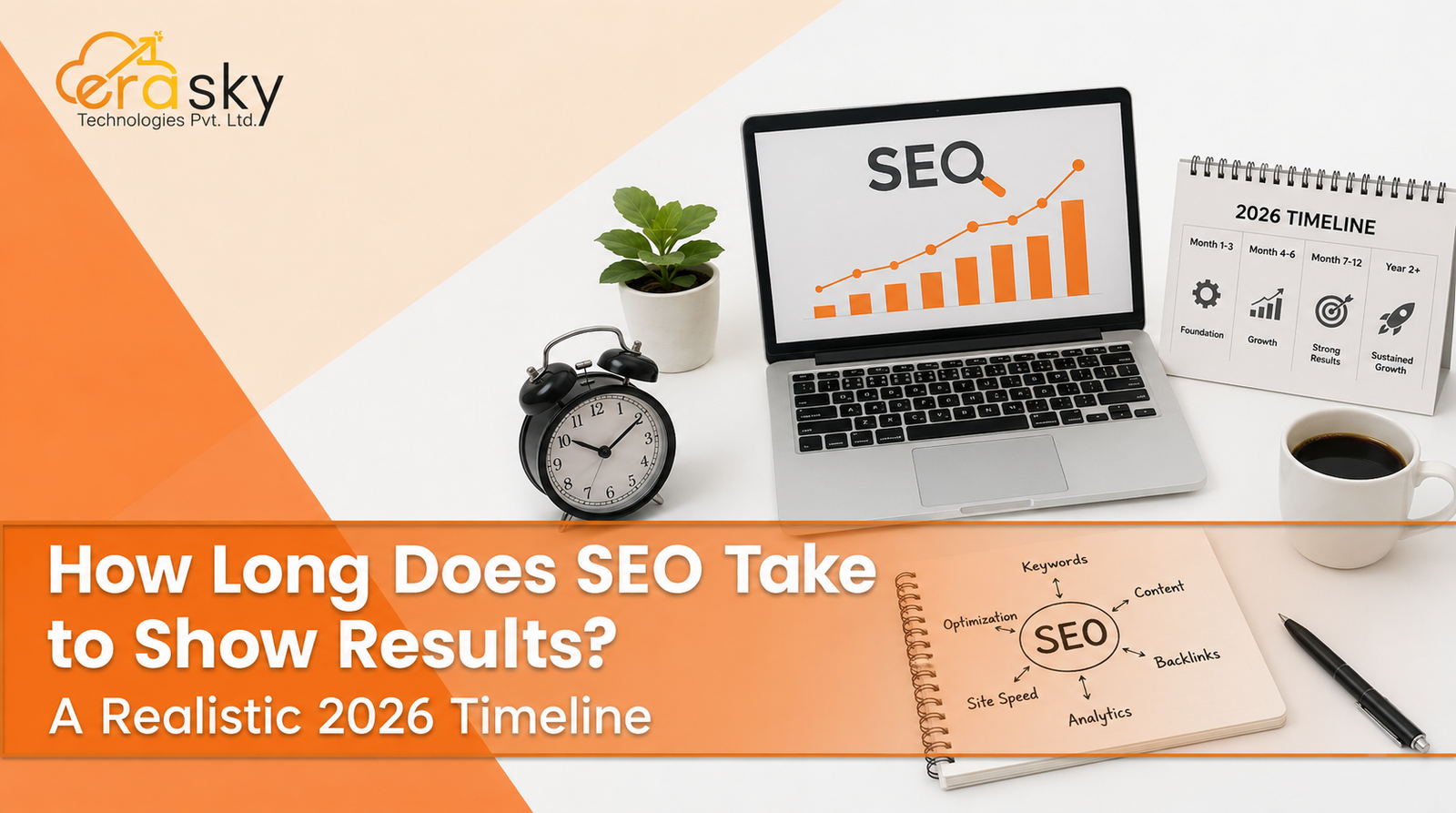
For many websites, the progression looks like this: Months 1 to 3: visibility develops. Months 3 to 6: traffic becomes more noticeable. Months 6 to 12: leads and ROI may become more consistent. Competitive industries can take longer. That is why how long for SEO to work cannot be answered with one fixed number.
Why Does SEO Take Time?
SEO works through accumulation. Google must first discover a page, crawl it, render it correctly, decide whether it belongs in the index, understand its subject, identify search intent, and compare it with competing pages. A well-optimized page is not automatically entitled to rank. It simply becomes eligible to compete.
SEO also compounds over time. Strong content improves topical coverage. Internal links help search engines understand page relationships. Backlinks increase authority. Older content gains historical performance signals. Rankings produce traffic, and traffic reveals which pages generate conversions. This is why SEO can feel slow at first and far more powerful later.
The Realistic SEO Timeline
Weeks 1 to 2: Research and Auditing
The first stage focuses on foundations.
Typical work includes:
- Technical SEO audits
- Keyword research
- Competitor analysis
- Search intent research
- Content reviews
- Backlink analysis
- Search Console setup
- Analytics setup
- Sitemap review
- Indexation analysis
Visible results are usually limited at this point. The main goal is to understand what is preventing growth and establish reliable measurement.
Weeks 2 to 4: Technical SEO
Technical SEO helps remove barriers that prevent search engines from crawling, understanding, or indexing pages effectively.
Typical tasks include:
- Fixing indexation problems
- Correcting canonical issues
- Repairing broken links
- Cleaning redirects
- Improving mobile usability
- Strengthening internal linking
- Improving Core Web Vitals
- Resolving duplicate content
- Adding relevant structured data
Some technical fixes can create quicker improvements, especially if important pages were being blocked or incorrectly indexed.
However, technical SEO usually removes limitations rather than creating authority on its own.
Month 1 to 2: Content Development
Once the website is technically stable, content becomes a major growth factor.
This phase may include:
- Improving service pages
- Publishing blogs
- Building topic clusters
- Updating old content
- Adding FAQs
- Improving headings
- Strengthening internal links
- Matching pages more closely with search intent
During this stage, new pages may begin appearing in Google, and long-tail keywords can start gaining visibility.
Traffic may still be modest, but the site is beginning to build a larger search footprint.
Month 2 to 3: Early Rankings
At this point, businesses may start seeing:
- More impressions
- Additional ranking keywords
- Early long-tail traffic
- Increased indexed pages
- Better visibility for optimized content
This does not necessarily mean predictable leads will appear yet.
The key signal is whether relevant search visibility is expanding.
Months 3 to 6: Measurable Growth
This is where many campaigns begin producing clearer movement.
Potential results include:
- Higher organic sessions
- More top-20 rankings
- Better click-through rates
- More commercial page traffic
- Improved local visibility
- Early organic enquiries
If almost nothing has changed after six months, the strategy should be reviewed carefully.
Possible causes include poor keyword targeting, weak content, technical problems, insufficient authority, low execution speed, or search intent mismatch.
Months 6 to 12: Stronger Organic Performance
By this stage, well-executed SEO can begin producing more reliable business outcomes.
A website may develop:
- More stable rankings
- Greater topical authority
- Higher-quality traffic
- Increased conversions
- More branded searches
- Better visibility for competitive keywords
At this point, businesses also have enough performance data to identify which topics, pages, and keywords produce the best commercial results.
Months 12 to 24: Competitive Growth
Competitive sectors often require a longer runway. Industries such as SaaS, finance, healthcare, travel, real estate, insurance, and ecommerce usually demand stronger authority and more sustained execution. At this stage, the goal shifts from gaining occasional rankings to building a durable organic presence.
How SEO Timelines Vary by Website Type
New websites usually take longer because they have fewer backlinks, limited content history, weaker brand recognition, and less established topical authority. A new website may take 4 to 6 months to gain initial traction and 12 to 18 months to establish stronger visibility. Local businesses can sometimes move faster, particularly when competition is limited geographically. Early progress may appear within 2 to 4 months. Ecommerce websites often take longer because of complex site structures, product duplication, category pages, internal linking, and competitive commercial keywords. SaaS and enterprise websites may require even more time because they often compete against established brands and face slower internal implementation.
What Determines How Fast SEO Works?
Website Authority
Established websites often gain traction faster because they already have backlinks, indexed pages, brand searches, and search history. Domain age alone is not the advantage. Accumulated authority is.
Competition
Low-competition terms can move faster. Highly competitive keywords require stronger content, better authority, greater relevance, and more patience.
Content Quality
Generic content is easier than ever to create. Strong SEO content in 2026 needs more than keywords. It should provide original insights, useful examples, expert interpretation, clear structure, and genuine relevance. AI can accelerate production, but it does not automatically create trust or authority.
Technical SEO
Problems such as crawl errors, duplicate content, incorrect canonical tags, broken internal links, poor mobile usability, and slow performance can delay growth.
Backlinks
Relevant, authoritative backlinks can strengthen rankings. Quality matters more than volume. Spammy links, automated placements, and irrelevant directories are unlikely to create sustainable performance.
Search Intent
A page can be technically perfect and still fail if it answers the wrong question. Informational searches require education. Commercial searches require comparisons, evidence, and decision support. Transactional keywords need strong service or product pages.
Internal Linking
Internal links help search engines discover pages, understand topical relationships, and distribute authority across the site. They also guide visitors toward deeper content and conversion opportunities.
Execution Speed
Sometimes SEO is not the bottleneck. Implementation is. If technical recommendations sit in a development queue for months or content takes weeks to approve, the effective SEO timeline becomes much longer.
What Slows SEO Down?
Common delays include:
- Thin content
- Duplicate pages
- Weak internal linking
- Poor site architecture
- Keyword stuffing
- Slow hosting
- Crawl problems
- Weak backlinks
- Inconsistent publishing
- Poor search intent alignment
- Low-quality AI content
- Weak conversion tracking
SEO often underperforms when businesses treat these issues separately. Strong content on a technically weak site can struggle. Good rankings on poor landing pages may generate traffic but no revenue. Authority without relevant content may produce limited gains. SEO works best when the whole system supports the same objective.
How to Make SEO Work Faster Without Shortcuts
Businesses cannot force sustainable rankings overnight, but they can remove unnecessary delays. The first priority should be fixing technical blockers. Next, target realistic opportunities such as long-tail keywords, local queries, commercial questions, comparison terms, and specific problem-based searches. Topic clusters also matter. Instead of publishing unrelated articles, businesses should create connected content around a central subject. This strengthens topical relevance and improves internal linking. Existing pages should not be ignored either. A page ranking in position 12 may need far less work to generate traffic than a new page starting from zero. Refreshing near-ranking pages, improving intent alignment, adding stronger evidence, and building relevant links can often deliver more efficient gains.
SEO Works Best as a Connected Growth System
SEO sits at the intersection of content, technical performance, authority, analytics, user experience, and conversion optimization. When these areas are managed separately, execution becomes fragmented. The content team may publish pages that are poorly structured technically. The SEO team may generate traffic to pages that do not convert. Link-building efforts may support low-value pages. This is where businesses often need more than an SEO vendor. They need coordinated execution.
Era Sky Technologies is well positioned for this type of requirement because the real challenge is not simply publishing content or tracking rankings. It is identifying which part of the organic growth system is holding performance back and fixing those elements in the right order. An integrated approach connects technical SEO, content strategy, authority building, analytics, and conversion performance around commercial outcomes rather than isolated deliverables.
What SEO Metrics Should You Measure?
SEO metrics should evolve with the campaign.
In month one, focus on:
- Indexing
- Crawl health
- Technical issues
- Analytics accuracy
During months two and three, monitor:
- Impressions
- Keyword visibility
- Click-through rates
- Non-branded exposure
During months three to six, focus more on:
- Organic sessions
- Top-20 rankings
- Landing-page traffic
- Qualified visitors
By months six to twelve, business metrics matter more:
- Leads
- Conversions
- Revenue
- Pipeline contribution
- Customer acquisition cost
- SEO ROI
Month one should not be judged mainly by revenue. Month twelve should not be judged mainly by impressions.
How AI Search Is Changing SEO in 2026
AI has changed how people discover information, but it has not eliminated SEO. AI Overviews, AI-driven search experiences, AEO, and GEO are increasing the importance of structured information, strong entity signals, expert insights, original data, and trustworthy content. AI makes content production faster. It does not make authority faster. As generic content becomes easier to create, distinctive expertise becomes more valuable. Businesses should therefore avoid chasing AI-specific shortcuts and instead focus on content that is useful enough to rank, credible enough to trust, and clear enough to be referenced across traditional and AI-powered search experiences.
Common SEO Timeline Myths
SEO does not reliably produce major results in a week. Publishing hundreds of AI articles does not guarantee rankings. Backlinks alone do not solve poor content or technical problems. Ranking first does not mean SEO is finished. Search behavior changes, competitors improve, algorithms evolve, and content ages. SEO remains an ongoing growth process.
Final Analysis: How Long Does SEO Really Take?
The practical answer to how long does SEO take to show results is usually 3 to 6 months for measurable movement and 6 to 12 months for stronger organic growth. Competitive industries may require 12 to 24 months or longer. But simply waiting is not a strategy. A website does not improve because time has passed. It improves because technical barriers are removed, content becomes more relevant, authority increases, internal linking strengthens, conversion paths improve, and execution remains consistent. The most useful question is therefore not: “When will Google reward us?” It is: “What is currently limiting our ability to compete?”
Conclusion
SEO becomes slow and unpredictable when businesses treat it as a collection of disconnected tasks. It becomes far more effective when technical SEO, content, authority, analytics, UX, and conversion strategy operate as one coordinated system. That is also where choosing the right SEO partner becomes important. A business may not need another agency that publishes blogs, sends ranking reports, or builds links in isolation. It may need a team that can diagnose the actual bottleneck, prioritize the right fixes, and connect SEO activity directly to business growth. That is where Era Sky Technologies stands out.
Its value lies in approaching SEO as a complete organic growth system rather than a checklist. By combining technical optimization, content strategy, authority development, analytics, and conversion thinking, Era Sky Technologies can help businesses build visibility that is not only measurable but commercially useful. The goal should not be to chase faster rankings at any cost. The goal should be to remove what is slowing growth, strengthen what is already working, and build an SEO system capable of compounding over time.
Frequently Asked Questions
How long does SEO take to work?
For most websites, how long does SEO take to work depends on competition, authority, technical health, content quality, and execution. Initial improvements often appear within 3 to 6 months.
Can SEO work in 30 days?
Some technical fixes, indexing improvements, and long-tail rankings can appear within 30 days. Significant organic growth usually takes longer.
How long does SEO take for a new website?
New websites may need 4 to 6 months for early traction and 12 to 18 months for stronger visibility.
Does blogging make SEO faster?
Blogging can help when content targets real search demand, supports topical authority, and connects to commercial pages through internal links.
Does AI change the SEO timeline?
AI can speed up research and content production, but it does not automatically accelerate authority, trust, or competitive rankings.
When should businesses expect SEO ROI?
Many businesses begin seeing stronger commercial returns within 6 to 12 months, while competitive markets may require 12 to 24 months.