Recent Posts
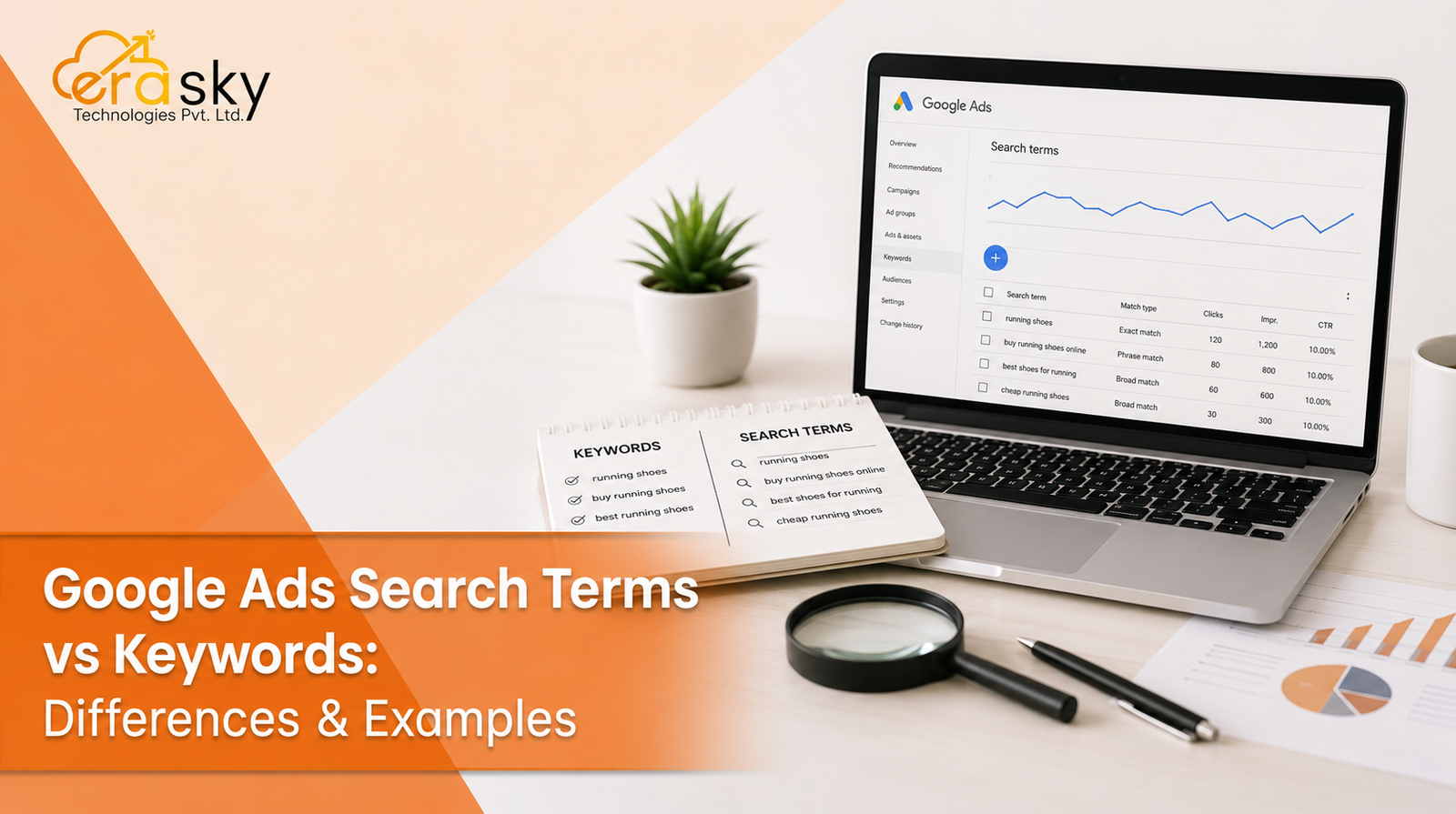
If you are running Google Ads, two terms can look almost identical but mean very different things: keywords and search terms.
Here is the simplest way to remember the difference:
A keyword is what an advertiser chooses to target. A search term is what a person actually types into Google.
For example, you may target the keyword emergency plumber, while someone searches for 24 hour emergency plumber near me. Google Ads uses its matching systems to determine whether the search is relevant to an eligible keyword and whether your ad can enter the auction.
That distinction matters because your keyword list represents your targeting strategy, while search terms show you real user behavior.
Understanding both helps you identify relevant searches, remove unwanted traffic, find new keyword opportunities, and improve campaign performance without relying on guesswork.
What Is a Keyword in Google Ads?
A keyword is a word or phrase that an advertiser adds to a Google Ads Search campaign to help identify the searches that may be relevant to an ad.
Think of a keyword as your intended target.
For example, a home services company might use keywords such as:
- emergency plumber
- commercial plumbing services
- water heater repair
- plumber near me
You choose these keywords based on your products, services, audience, location, and campaign goals.
Keywords can also be assigned match types, including broad match, phrase match, and exact match. Match types influence how closely a user's search needs to relate to the keyword for your ad to be eligible.
However, a keyword is not a list of exact searches that Google is required to match word-for-word.
That is where search terms become important.
What Is a Search Term in Google Ads?
A search term is the actual word or phrase a user enters into Google Search when looking for something.
For example, your keyword might be:
Keyword: emergency plumber
A user could search:
Search term: 24 hour emergency plumber near me
Another user might search:
Search term: emergency plumbing company in Dallas
These searches are different from the keyword, but they may still be relevant enough for the keyword to match.
Google Ads can show search-term information through the Search Terms Report, although the report does not necessarily expose every query entered by every user. Google limits some search-term reporting for privacy and other reasons.
The report is therefore not just a record of what you intended to target. It is a source of evidence about how people actually search before clicking your ads.
Google Ads Search Terms vs. Keywords: What Is the Difference?
The core difference is simple.
A keyword comes from the advertiser.
A search term comes from the user.
A keyword is part of your campaign's targeting structure. A search term is part of the user's real search behavior.
They also serve different purposes.
Your keyword list helps Google understand the subjects and themes you want your campaign to participate in. Search-term data helps you understand which real queries are interacting with that targeting.
So, if your keyword is running shoes, actual search terms could include:
- best running shoes for flat feet
- men's running shoes
- running shoes for marathon training
- cheap running shoes near me
Some may be valuable. Some may be too broad. Some may have a completely different intent.
That is why you should not judge a keyword solely by its wording. You should examine what searches it actually attracts and whether those searches produce useful business outcomes.
Do Google Ads Keywords Have to Match Search Terms Exactly?
No.
This is one of the most important concepts to understand.
A search term does not have to be an identical text match to the keyword that ultimately becomes relevant to the ad auction.
Google Ads considers the keyword's match type and its matching systems when determining whether a search is relevant to a keyword.
For example, a business may target:
Keyword: dental implants
A user could search:
Search term: affordable dental implants in Miami
The search term contains additional information about price and location, but the underlying subject is still dental implants.
Likewise, a search can sometimes reveal an intent mismatch.
Suppose the keyword is:
Keyword: HVAC repair
But the user searches:
Search term: how to fix an HVAC system yourself
The topic is related, but the user's intent may be informational rather than commercial. That distinction can matter greatly when the objective is generating qualified leads.
How Keyword Match Types Affect Search Terms
Match types help shape the relationship between your keywords and the searches that may be eligible to trigger your ads.
Broad Match
Broad match gives Google more flexibility to identify searches related to the meaning or intent of your keyword.
That can help campaigns reach additional relevant searches, but it also makes search-term monitoring particularly important.
The key question is not simply, "Did the keyword trigger my ad?"
It is: "Were the searches useful to my business?"
Phrase Match
Phrase match provides more control than broad match while still allowing your ad to appear for searches related to the meaning of the keyword.
The actual search does not need to be a perfect text copy of the keyword.
Exact Match
Despite its name, exact match does not mean the user must type the exact same characters in the exact same form.
Google's matching systems allow exact-match keywords to reach certain searches with the same meaning or close variants.
So emergency plumber does not necessarily mean only that precise sequence of words will qualify.
The broader lesson is simple: match type affects eligibility, while search-term analysis tells you what actually happened.
Why the Search Terms Report Matters
The Search Terms Report is where the difference between keywords and search terms becomes genuinely useful.
Imagine you are targeting:
Keyword: commercial cleaning services
After collecting enough reportable data, you might discover searches such as:
- commercial cleaning services for offices
- janitorial services for warehouses
- commercial cleaners near me
- janitorial jobs near me
- free cleaning business course
The first three could represent useful commercial opportunities.
The last two may represent poor-fit traffic if your business is trying to generate cleaning-service customers.
This creates several optimization opportunities.
You may discover a search worth adding to your keyword strategy.
You may find an irrelevant search that should become a negative keyword.
You may also discover that your campaign is attracting a completely different audience or intent than you expected.
That is why search-term analysis should be treated as an ongoing optimization activity, not a one-time cleanup exercise.
When Should You Add a Search Term as a Keyword?
A search term may deserve its own keyword when it shows a strong combination of relevance, intent, and business value.
For example, suppose you advertise business insurance and repeatedly see searches for:
small business insurance for contractors
That search is more specific than the original keyword business insurance and may represent a valuable audience segment.
You might decide to build more targeted keyword coverage around that theme, especially if the search term aligns with the products you actually offer and the traffic converts well.
Do not promote every interesting search term into a keyword.
The goal is not to build the largest possible keyword list. The goal is to build a useful and controllable targeting structure.
When Should You Add a Negative Keyword?
A search term should be considered for exclusion when it is clearly irrelevant or consistently brings the wrong type of user.
For example:
Keyword: paid advertising agency
Search term: free advertising courses
The person may be looking for education, not an agency.
Another example:
Keyword: commercial cleaning services
Search term: janitorial jobs near me
The searcher appears to be looking for employment rather than hiring a service.
Adding an appropriate negative keyword can help prevent ads from appearing for unwanted searches.
Negative keyword decisions should still be made carefully. A single unusual query does not always justify excluding a broader term. Look for intent, relevance, patterns, and performance before making major changes.
What Should You Look for During Search-Term Analysis?
A useful review goes beyond asking whether a query contains your keyword.
Look for:
Relevant high-intent searches: Queries that closely align with your product or service and show meaningful buying or lead intent.
Irrelevant searches: Queries related by words but not by business purpose.
New keyword opportunities: Specific search themes that deserve more deliberate targeting.
Location intent: Searches containing cities, states, neighborhoods, or phrases such as "near me."
Audience specificity: Searches that reveal a valuable customer segment.
Conversion patterns: Search terms associated with stronger lead or sales performance.
For businesses focused on lead generation, this analysis can be especially important because a click is not the final objective. The real question is whether the search brings a person who is genuinely likely to become a customer.
Keywords Set the Strategy. Search Terms Reveal Reality.
This is the distinction worth remembering:
Keywords represent what you intend to target. Search terms reveal what users actually searched.
Neither one is more important in every situation.
Your keyword strategy provides structure. Search-term data provides feedback.
Together, they create a practical optimization loop:
Choose relevant keywords → run the campaign → collect search-term data → identify valuable and irrelevant queries → refine keywords and negative keywords → measure conversions → optimize again.
That process is far more useful than endlessly adding keywords based only on assumptions.
For businesses investing significant amounts in Google Ads, this is one reason campaign management requires more than writing ads and setting a budget. Search behavior changes, competition changes, and the quality of traffic can vary substantially even when the keyword list looks reasonable.
Era Sky Technologies approaches paid advertising through a broader analysis, strategy, execution, measurement, and optimization process. Its paid advertising services include campaign planning, audience targeting, conversion tracking, budget management, and A/B testing. The company also brings website, SEO, and technical capabilities into the same digital ecosystem, which can be useful when advertising performance depends on the landing-page experience as well as the campaign itself.
The objective should not be to promise a particular return from every campaign. Google Ads performance can change with competition, search demand, audience behavior, platform policies, budget, offers, creative quality, and conversion tracking.
The objective is to make decisions from better data.
FAQs
Are Google Ads search terms and keywords the same?
No. A keyword is selected by the advertiser as part of the campaign's targeting strategy. A search term is the actual query entered by a user into Google.
Can one keyword match multiple search terms?
Yes. Depending on the match type and Google's matching systems, one keyword can be relevant to many different search terms.
Why doesn't my search term exactly match my keyword?
Google Ads does not rely only on literal word-for-word matching. Match types and Google's matching systems can allow related searches, including searches with different wording or the same underlying meaning.
How can I find the search terms that triggered my ads?
Use the Search Terms Report in Google Ads. The available report data can help you examine the actual queries associated with your ads, although Google does not necessarily reveal every search because of reporting and privacy thresholds.
When should I add a search term as a keyword?
Consider it when the search is highly relevant to your offer, reflects useful intent, and provides a meaningful targeting opportunity. Performance and conversion data can strengthen the case for adding it.
When should I add a negative keyword?
Consider a negative keyword when a search is clearly irrelevant or repeatedly attracts users who are unlikely to become the customers you want. Review the broader context before excluding a term.
Which is more important: keywords or search terms?
They serve different purposes. Keywords define your targeting strategy, while search terms show how real users interact with that strategy. Strong Google Ads optimization uses both.
Final Takeaway
Google Ads keywords are the targets you choose. Search terms are the searches users actually make.
Once you understand that difference, the Search Terms Report becomes much more than a reporting feature. It becomes a practical source of insight for refining targeting, discovering opportunities, excluding irrelevant traffic, and improving the quality of your Google Ads campaigns.
The strongest campaigns are not built only on what an advertiser thinks people will search.
They improve by learning from what people actually search.