Recent Posts
You hire a marketing team. Months go by. Costs rise, execution slows, and results feel inconsistent.
So you switch. You decide to outsource digital marketing services to an agency. Campaigns launch faster. Performance improves. But over time, you start noticing gaps in control, messaging, and alignment.
If this sounds familiar, you are not alone.
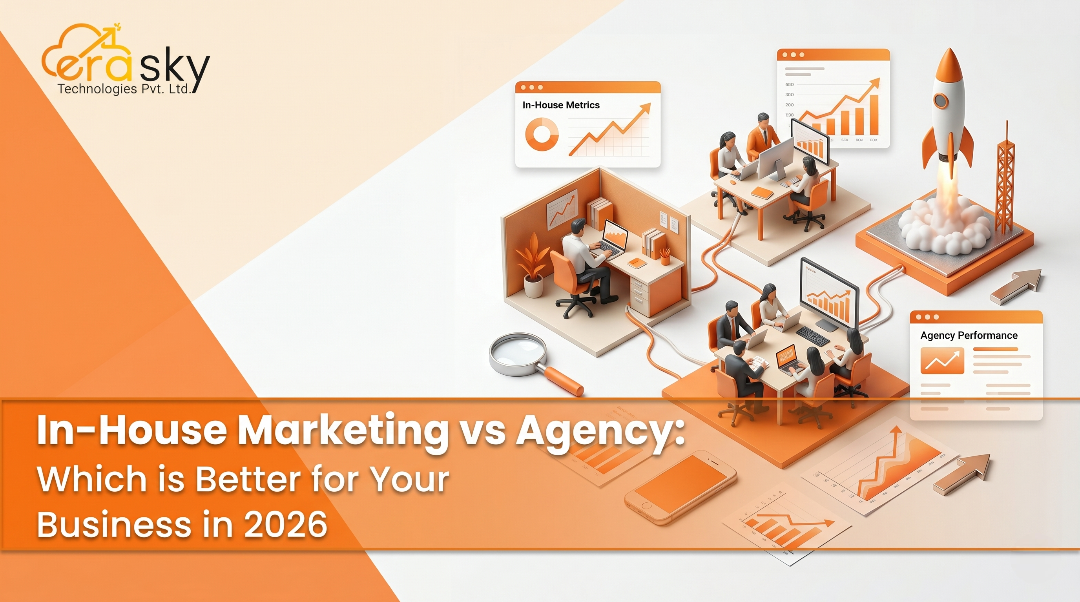
In 2026, the decision between digital marketing agency vs in house is no longer simple. Marketing has evolved into a complex system that requires strategy, execution, data ownership, and continuous optimization across multiple channels.
The real question is not just who should handle your marketing. It is how your marketing capability should be structured.
This article breaks down the reality, costs, performance differences, and strategic implications so you can make a decision that actually drives growth.
The Current Landscape: Why This Decision Is More Complex Than Ever
Marketing has fundamentally changed over the past few years.
- 91% of brands are bringing some marketing in-house
- 66% already operate internal teams
- 85% of marketing roles now sit internally
- Yet nearly 46% of marketing activities are still outsourced
This creates a clear insight.
Businesses are not choosing between models. They are combining them.
The rise of AI tools, first-party data strategies, and omnichannel marketing has made it nearly impossible for a single marketing team to handle everything effectively.
Today, marketing requires expertise in:
- Paid media
- SEO
- Conversion rate optimization
- Analytics
- Automation
- Content strategy
That is why the conversation around digital marketing agency vs in house is shifting toward hybrid models.
The Real Problem: Most Businesses Build Marketing the Wrong Way
The biggest mistake founders make is assuming this is a hiring decision.
It is not.
It is a structural decision.
Most businesses struggle because of:
1. Underestimating Marketing Complexity
Hiring two or three people does not create a complete marketing engine. It creates gaps.
2. Conflicting Expectations
Businesses want speed, control, low cost, and high performance at the same time. That combination rarely exists in a single model.
3. Skill Gaps
An internal marketing team often lacks deep specialization across all channels.
4. Data Misalignment
Without a clear data ownership strategy, performance tracking becomes fragmented.
5. Execution Bottlenecks
Internal workflows slow things down, while external teams may lack context.
The issue is not whether you choose an agency or build internally. The issue is how your marketing system is designed.
Digital Marketing Agency vs In House: Key Performance Factors
Control vs Flexibility
An in-house team gives you full control over messaging, brand, and execution priorities. However, this often comes at the cost of speed.
An agency provides flexibility and faster execution, but with less direct control.
This trade-off directly impacts decision-making speed and campaign performance.
Expertise and Capability
An internal marketing team usually consists of generalists or a few specialists.
An agency offers access to a full outsourced marketing department with experts across multiple disciplines.
This is one of the major benefits of hiring a marketing agency, especially for businesses that need multi-channel execution.
Cost Structure
In-house marketing includes:
- Salaries and benefits
- Hiring and onboarding costs
- Tools and software
- Attrition costs
Agency marketing includes:
- Monthly retainers or project fees
- Built-in tools and systems
- No HR overhead
In 2026, average benchmarks show:
- Agency model: around $96K per year
- In-house model: around $276K per year
This makes outsource digital marketing services a more cost-effective option in the short term.
Speed to Results
Agencies can launch and optimize campaigns within 4 to 6 weeks.
An internal team often takes 6 to 12 months to reach full efficiency.
Speed matters, especially in competitive markets where delays directly affect revenue.
Scalability
An agency allows you to scale campaigns up or down quickly.
An in-house structure is harder to adjust due to fixed resources.
This makes an outsourced marketing department more suitable for businesses in growth or expansion phases.
Innovation and Testing
Agencies run campaigns across multiple industries. This exposure allows them to test faster and apply proven strategies.
An internal team typically operates within a narrower scope, which limits experimentation.
The Benefits of Hiring a Marketing Agency
When executed correctly, the benefits of hiring a marketing agency go far beyond cost savings.
1. Access to Specialized Expertise
You get a team of experts in SEO, paid ads, analytics, and conversion optimization without hiring each role individually.
2. Faster Execution
Campaigns move from idea to launch quickly, reducing time-to-market.
3. Built-In Tools and Technology
Agencies bring advanced tools that would otherwise require significant investment.
4. Scalability
You can adjust resources based on demand without long-term commitments.
5. Cross-Industry Insights
Agencies apply learnings from different industries, which leads to better strategies and innovation.
These advantages make agencies a strong choice for businesses that need speed and performance.
Where In-House Marketing Still Wins
Despite the advantages of outsourcing, in-house marketing has critical strengths.
1. Deep Brand Understanding
An internal marketing team is fully immersed in your product, culture, and audience.
2. Data Ownership
In 2026, controlling first-party data is a major competitive advantage.
3. Long-Term Efficiency
For stable businesses with consistent needs, in-house teams can become more cost-efficient over time.
4. Internal Collaboration
Faster communication with product, sales, and leadership teams improves alignment.
The Rise of the Hybrid Model
The most effective approach today is not choosing one over the other.
It is combining both.
A hybrid model typically looks like this:
- Strategy and brand managed in-house
- Execution handled by an outsourced marketing department
- Data owned internally
- Optimization shared between both
This structure allows businesses to balance control, expertise, and scalability.
It also reflects how modern marketing actually operates.
Cost and ROI: What the Numbers Really Say
Short-term:
- Agencies deliver faster ROI
- Lower upfront investment
- Better for testing and scaling
Long-term:
- In-house becomes more efficient
- Better for brand consistency and control
However, agencies often deliver 3 to 5 times better ROI in early stages due to:
- Faster execution
- Advanced testing
- Access to experienced specialists
This is why many businesses choose to outsource digital marketing services during growth phases.
How to Decide What’s Right for Your Business
Choose In-House If:
- Marketing is a core competency
- You need full control over data and messaging
- Your growth is stable and predictable
Choose an Agency If:
- You need fast results
- You lack internal expertise
- You are entering new markets
- You want flexibility
Choose a Hybrid Model If:
- You want both control and performance
- You are scaling aggressively
- You need specialized execution without losing strategic oversight
For most businesses in 2026, hybrid is the most practical and effective solution.
Emerging Trends Shaping This Decision
AI Is Changing Execution
AI tools are making it easier for internal teams to handle basic tasks, but advanced strategy and optimization still require expertise.
First-Party Data Is Critical
Businesses are prioritizing data ownership more than ever.
Marketing Budgets Are Under Pressure
Budgets have dropped from 9.1% to 7.7% of revenue, increasing the demand for efficiency.
Agencies Are Evolving
Many agencies now operate as performance partners rather than service providers.
Key Insight: This Is Not a Binary Decision
There is no universal winner in the digital marketing agency vs in house debate.
The real shift is this:
From choosing a model
To designing a system
- In-house provides control and long-term efficiency
- Agencies provide speed, expertise, and scalability
- Hybrid models provide competitive advantage
The businesses that win are the ones that structure their marketing as an integrated ecosystem.
Conclusion
If your marketing feels slow, expensive, or inconsistent, the problem is rarely your people.
It is your structure.
A well-designed system aligns:
- Strategy
- Execution
- Data
- Performance
Instead of asking whether to hire or outsource, focus on building the right combination of capabilities.
This is where a strategic partner like Era Sky Technologies becomes valuable. Not just as a service provider, but as a team that helps you design and execute a complete marketing system.
If you want better results, start with a clear structure. Then scale with the right mix of internal strength and external expertise.
FAQs
Is it better to hire a marketing agency or build an in-house team?
It depends on your business stage. Agencies are better for speed and expertise, while in-house teams are better for control and long-term efficiency.
What are the benefits of hiring a marketing agency?
The main benefits of hiring a marketing agency include specialized expertise, faster execution, scalability, and access to advanced tools.
Is it a good idea to outsource digital marketing services?
Yes, especially for growing businesses. It reduces upfront costs and provides faster access to experienced professionals.
What is an outsourced marketing department?
An outsourced marketing department is an external team that handles your marketing functions such as ads, SEO, content, and analytics.
When should a business build an internal marketing team?
When marketing becomes a core function and there is a need for full control over brand, messaging, and data.
What is the difference between digital marketing agency vs in house?
The main difference is that an agency provides external expertise and scalability, while in-house teams offer control and deeper brand alignment.