Recent Posts
Introduction
Most businesses do not struggle with Google Ads because of lack of effort. They struggle because they are using the wrong campaign type for the wrong job. A common pattern shows up across accounts of all sizes. Search campaigns are expected to generate awareness. Display campaigns are judged by direct conversions. Budgets get shifted based on short-term results, not long-term funnel logic. The outcome is predictable: rising costs, unstable leads, and inconsistent ROI.
Modern Google Ads has moved far beyond simple placement-based advertising. It now functions as an AI-driven system that distributes traffic across intent levels, audience signals, and behavioral prediction models. In this environment, understanding google ads campaign types is no longer optional. It is the difference between controlled growth and unpredictable performance.
This article breaks down how search engine advertising vs display marketing actually work in 2026, how they fit into the funnel, and how businesses can use both strategically instead of competitively.
1. The Current Landscape (Updated Reality 2025–2026)
Google Ads is no longer a keyword-first platform. It has evolved into an AI-driven allocation engine that decides where ads appear based on intent probability rather than strict targeting rules.
Today’s ecosystem includes multiple campaign types:
Search, Display, Video, Shopping, App, Performance Max, Demand Gen, and AI Max for Search.
The most important shift is structural. Campaign types are no longer just channels. They represent funnel positions and AI optimization behaviors.
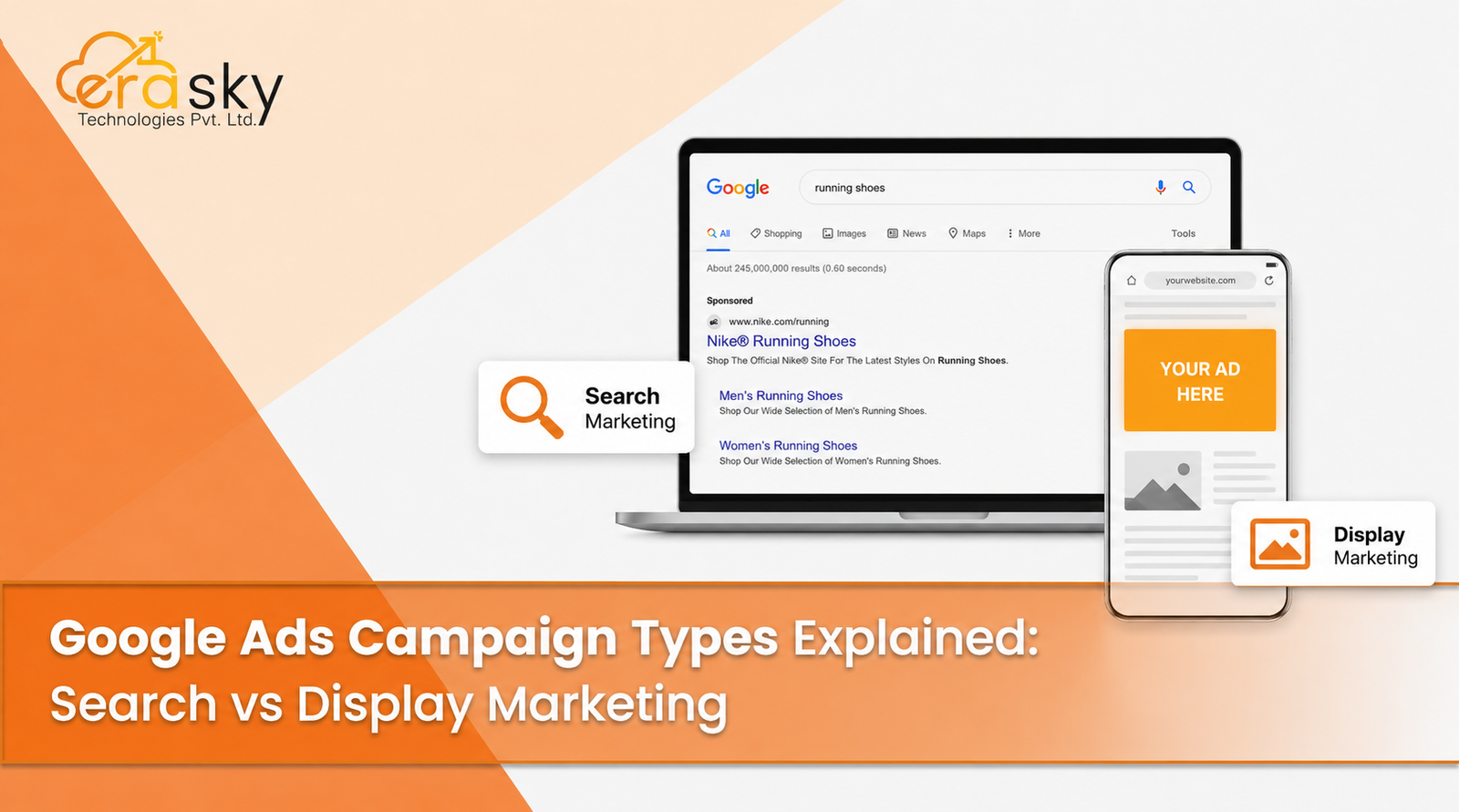
- Search is primarily intent capture
- Display is primarily demand creation
- Performance Max blends multiple systems into automated distribution
- Demand Gen drives discovery across visual and social-style surfaces
This evolution means advertisers cannot rely on traditional segmentation. The system itself now blends audiences and placements dynamically. Manual control still matters, but only when aligned with funnel logic.
2. Core Problem Breakdown (Why Most Accounts Underperform)
The majority of underperformance in Google Ads does not come from technical mistakes. It comes from structural misunderstanding.
Misunderstanding 1: Intent Confusion
Many advertisers treat what is search advertising as a broad awareness tool. In reality, search is a high-intent capture mechanism. Users are already looking for a solution. The role of search is not to create demand but to intercept it. On the other hand, display advertising examples show a completely different behavior pattern. Users are not actively searching. They are browsing content, watching videos, or using apps. Display works by influencing attention before intent fully forms.
Misunderstanding 2: Funnel Blindness
Without funnel mapping, budgets are allocated based on surface-level performance. Search looks profitable, so it gets more budget. Display looks weak, so it gets cut. This removes the very system that feeds future search demand.
Misunderstanding 3: Attribution Gaps
Display is often undervalued because it rarely receives last-click credit. However, it frequently contributes earlier in the decision cycle. Search then captures the final conversion, making Display’s influence invisible without proper analysis. The result is a distorted system where only the final touchpoint is rewarded, not the entire journey.
3. Key Factors Affecting Performance
3.1 Intent Strength
Search operates on explicit intent. Users are actively searching for solutions, comparisons, or services. This creates high conversion probability but also increases competition and cost.
Display operates on implicit intent. It targets users based on behavior, interests, or contextual signals. The intent is formed gradually rather than immediately.
3.2 Targeting Mechanism
Search relies on keyword-based targeting, which allows precise control over demand capture but limits reach. Display uses audience modeling, remarketing, and contextual signals. This enables scale but reduces immediate precision.
3.3 Creative Dependency
Search ads are primarily text-driven and depend heavily on relevance and offer clarity. Display ads depend on visual storytelling, messaging hierarchy, and emotional engagement. Without strong creatives, performance drops quickly regardless of targeting quality.
3.4 Funnel Positioning
Search sits at the bottom of the funnel. It captures demand that already exists. Display sits at the top and middle of the funnel. It creates familiarity and builds future demand. This distinction is often ignored, leading to misaligned expectations.
3.5 AI System Influence
Modern Google Ads integrates AI across all campaign types. Search now includes keyword expansion through AI Max for Search. Display uses predictive audience modeling and cross-device behavior tracking. This means optimization is no longer fully manual. The system itself decides distribution based on predicted outcomes.
4. Strategic Fixes and Frameworks
A structured approach is required to align campaign types with business goals.
Step 1: Define Intent Layer
Start by categorizing your audience:
- High intent users belong in search campaigns
- Low or developing intent users belong in display campaigns
Step 2: Separate Funnel Functions
Do not treat campaigns as interchangeable.
- Search should focus on conversions
- Display should focus on awareness, engagement, and remarketing
Step 3: Align Messaging to Stage
Messaging must match intent level.
- Search messaging should be direct, solution-oriented, and action-focused
- Display messaging should focus on problem awareness, brand recall, and curiosity
Step 4: Use Automation Strategically
Automation should support structure, not replace it. Over-reliance on fully automated systems without funnel clarity leads to diluted performance signals.
5. Systems Thinking (Ecosystem View)
Search and Display are not competing systems. They are interconnected layers of a single acquisition engine. Search captures existing demand. Display builds future demand. When combined properly, they create a compounding effect where awareness generated in Display increases Search conversions over time. Modern systems like Performance Max further integrate these layers by distributing traffic dynamically across channels. This is why isolated optimization often fails. It ignores how the system actually operates as a whole. In practice, businesses that scale efficiently tend to structure their campaigns as integrated ecosystems rather than separate channels. This requires both strategic clarity and disciplined execution, something typically handled by specialized performance teams like Era Sky Technologies, which focus on aligning campaign architecture with AI-driven distribution models.
6. Data, Benchmarks, and Performance Metrics (2025–2026)
Understanding benchmarks helps set realistic expectations.
Search Ads
- Average CPC: around $5 or higher depending on industry
- CTR: approximately 6 to 8 percent
- Conversion rate: often 5 to 10 percent or more in strong accounts
Display Ads
- Average CPC: significantly lower, often below $1
- CTR: typically 0.3 to 0.5 percent
- Direct conversion rate: under 1 percent in most cases
However, these numbers do not tell the full story.
Search is optimized for direct conversion efficiency. Display is optimized for scale and influence. Many conversions attributed to search are actually influenced earlier by display exposure.
Key performance indicators that matter more than surface metrics include:
- Assisted conversions
- View-through conversions
- Impression share trends
- Return on ad spend over full customer journey
7. Emerging Trends and Future Direction
Google Ads is rapidly evolving toward full automation and predictive targeting.
Key trends include:
- AI Max for Search reducing reliance on exact keywords
- Demand Gen replacing traditional discovery campaigns
- Increased importance of creative-driven performance in Display
- Expansion of cross-platform behavioral targeting
- Declining organic click-through rates due to AI-generated search summaries
The direction is clear. Campaign structure is becoming less about manual control and more about system design. Businesses that adapt early to this shift will gain a compounding advantage.
8. Interesting Insights and Lesser-Known Facts
- A large portion of Display influence is never credited in last-click attribution models
- Search campaigns often perform better when supported by prior Display exposure
- Many high-performing accounts allocate a significant portion of budget to upper funnel activity
- AI-driven campaigns can override manual keyword structures based on predicted intent
- Lower CTR in Display does not necessarily indicate poor profitability when viewed across full funnels
- Search demand is frequently created weeks earlier through non-search touchpoints
These insights challenge the conventional way performance is evaluated.
9. Final Analysis (Big Takeaway)
The real misunderstanding in Google Ads is not about choosing between search engine advertising vs display marketing. It is about expecting both to perform the same role. Search captures intent that already exists. Display creates the conditions for intent to form. When treated separately, performance feels inconsistent. When treated as a system, performance becomes predictable. Modern advertising success depends on how well these layers are structured, connected, and interpreted through the lens of funnel behavior rather than isolated metrics.
Conclusion
Google Ads has moved far beyond simple campaign selection. It now operates as an AI-driven ecosystem where each campaign type plays a specific role in guiding users from awareness to conversion. Understanding google ads campaign types is no longer just a technical skill. It is a strategic requirement for any business investing in paid acquisition. Search ensures demand capture. Display ensures demand creation. Together, they define how efficiently a business grows in a competitive digital environment. The challenge most businesses face is not access to tools, but the lack of a structured system that connects these tools effectively. Without that structure, even high budgets produce unstable results.
This is where strategic alignment becomes critical. Businesses that treat Google Ads as a connected ecosystem rather than separate channels consistently achieve stronger efficiency and more predictable scaling. Execution at this level often requires dedicated systems thinking, where campaign architecture, creative strategy, and AI behavior are aligned under one framework. Teams like Era Sky Technologies typically operate in this space, focusing on building that structural clarity so advertising spend translates into consistent growth rather than fragmented outcomes.
The next stage of performance marketing is not about adding more campaigns. It is about building smarter systems. Connect with our team today if you want to learn more!