Recent Posts
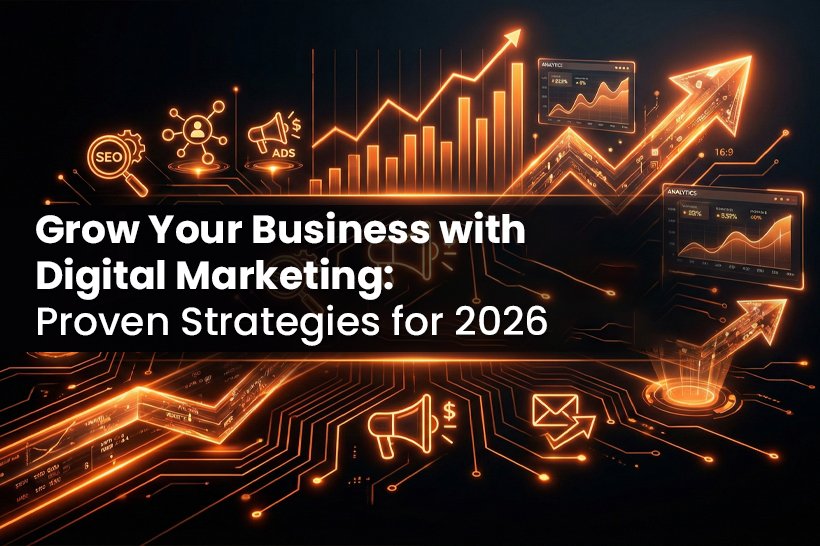
Introduction: Why Digital Marketing Feels Harder Than Ever in 2026
If digital marketing feels more complex than it used to, that’s because it is. Platforms are evolving faster, customer trust is harder to earn, and competition is no longer limited by geography. Strategies that delivered results even a few years ago are now less reliable, more expensive, or ineffective altogether.
In this guide, you’ll learn how to grow your business with digital marketing by understanding what has changed, why those changes matter now, and how high-performing businesses are adapting in response. You’ll gain clarity on which strategies continue to drive measurable growth, which ones quietly drain budget, and how to build a structured system that supports sustainable, long-term results rather than short-term peaks.
By the end, you should have a clear, practical understanding of where to focus your efforts next without unnecessary complexity or guesswork.
Why Your Business Isn’t Growing Even If You’re “Doing” Digital Marketing
Many businesses are active online but still struggle to see consistent growth. The issue is not just an effort but a clear direction.
You might be publishing content, running ads, sending emails, or posting on social media. But if these activities are not connected to a clear growth objective, they turn into noise. Digital marketing starts to feel unpredictable, and ROI becomes hard to explain.
In markets like the UK, USA, and Canada, this challenge is amplified by compliance requirements, consent management, and privacy-focused tracking. If your data is incomplete or unclear, even good campaigns can underperform because decisions are based on assumptions instead of insight.
To grow your business with digital marketing, you need alignment before activity.
What Has Changed Recently and Why It Matters to You
Digital marketing in 2026 is shaped by three major shifts that directly affect your results.
Data Privacy Has Changed How Tracking Works
Data privacy rules and platform updates have changed how you track and target users. With cookie limits, GA4, and stricter consent requirements, passive tracking no longer works. You now need to rely on first-party data and CRM-based insights to understand what is performing well. Without this shift, it becomes harder to see which efforts are driving real results.
Quality Now Matters More Than Quantity
Search engines and social platforms no longer reward volume alone. Publishing more content or increasing ad spend does not automatically improve performance. What matters is relevance, like how closely your message matches what users are actually looking for. Content and ads that show depth and clear intent perform better than broad & high-volume efforts.
AI Helps You Work Faster, Not Think for You
AI tools make it easier to create and analyze marketing materials, but they do not replace strategy. Without human control, clear brand guidelines, and compliance checks, AI-driven marketing can weaken trust. The most effective businesses use AI to support execution while keeping decision-making firmly in human hands.
Understanding these changes is critical if you want to grow your business with digital marketing rather than fight against the system.
A Practical Way to Grow Business with Digital Marketing in 2026
Successful businesses today approach digital marketing as a system, not a collection of tactics.
It starts with clarity. You need to know what growth means for your business right now. Are you trying to increase qualified leads, shorten your sales cycle, enter a new market, or improve retention? When your goal is clear, every digital decision becomes easier.
From there, authority becomes your advantage. Customers are more cautious, and trust is earned slowly. When your website, content, ads, and messaging consistently demonstrate understanding of real problems, you stop competing purely on price or visibility. You start attracting people who are already inclined to choose you.
Data becomes a decision tool rather than just a reporting metric. Instead of focusing only on traffic, you analyze user behavior, connect marketing platforms with your CRM, and track how leads actually convert. This clarity helps you invest with confidence and avoid wasted spending. With this foundation in place, the next step is execution. Below are proven digital marketing strategies that businesses are using in 2026 to turn this structure into measurable, scalable growth.
1. Build Growth Around a Clear Business Outcome, Not Channels
One of the biggest reasons businesses struggle to grow with digital marketing is that they start with channels instead of outcomes. You might ask, “Should we invest in SEO, paid ads, or social media?” when the better question is, “What does growth actually mean for us right now?”
- If your goal is better lead quality, your focus shifts toward intent-driven content and qualified traffic.
- If your goal is market expansion, your strategy prioritizes visibility, awareness, and reach in new regions.
- If your goal is revenue efficiency, every channel is optimized for conversion and cost control.
When you align digital marketing with one clear outcome, everything becomes more focused. Your messaging is clearer, your targeting is sharper, and your performance metrics start to reflect real business impact.
Businesses that skip this step often feel busy but stuck. Those that get it right see momentum faster, even with smaller budgets.
2. Use Authority-Led Content to Earn Trust Before the Sale
In 2026, customers don’t convert because you’re visible - they convert because they trust you. This is especially true in competitive markets like the UK, USA, and Canada, where buyers compare options carefully and expect expertise.
Authority-led content focuses on real decisions your audience is trying to make. Instead of explaining concepts at a surface level, it addresses risks, trade-offs, and outcomes. It shows that you understand not just the “what,” but also the “why” and “how.”
When your content reflects real-world experience, operational awareness, and clarity, it does more than rank in search. It pre-qualifies leads and shortens the sales cycle. Without this approach, you may attract traffic, but not the right conversations.
3. Treat SEO as a Long-Term Growth Asset, Not a Traffic Tactic
SEO is still one of the most reliable ways to grow your business with digital marketing—but only if you treat it as a system. In 2026, SEO is less about keywords and more about intent, structure, and credibility.
High-performing businesses build content around topic depth rather than isolated blog posts. They update content as markets change, ensure technical foundations are strong, and design pages for both users and answer engines.
If your SEO strategy is outdated or inconsistent, you may be invisible to high-intent buyers without realizing it. When done correctly, SEO compounds over time and reduces dependency on paid channels.
4. Run Paid Advertising With Control, Not Urgency
Paid advertising still works, but the rules are stricter. Platforms now reward relevance, user experience, and clarity. Simply increasing spending no longer guarantees results.
Successful businesses use paid media to validate and scale what already works. They test messaging carefully, align ads with landing page experience, and track behavior beyond the first click. They also respect privacy and compliance requirements, which directly affect targeting and performance.
If paid ads feel unpredictable or expensive, the issue is usually strategy, not the platform. When controlled properly, paid media becomes a growth accelerator instead of a budget drain.
5. Turn Data Into Decisions, Not Just Reports
Most businesses have data, but very few use it well. Dashboards look impressive, yet decisions are still made on instinct.
In 2026, growth-focused teams use analytics to understand behavior, not just activity. They track how users move through the funnel, which channels produce qualified leads, and where prospects drop off. CRM integration plays a critical role here, especially in privacy-first environments.
When data informs decisions, marketing becomes calmer and more confident. Without this clarity, scaling always feels risky.
6. Use Lifecycle Marketing to Multiply Results You Already Paid For
One of the most overlooked ways to grow your business with digital marketing is lifecycle marketing. Many businesses focus heavily on acquisition but neglect what happens after the first interaction.
Email, CRM automation, and behavior-based nurturing help you stay relevant throughout the buying journey. Instead of pushing promotions, you guide prospects with timely, useful content that supports their decision-making.
Businesses that invest here see higher conversion rates, better retention, and stronger lifetime value. Those that don’t often spend more just to replace lost opportunities.
What You’re Missing If You Don’t Use These Strategies
Without a structured digital marketing approach, growth often feels fragile. Costs rise faster than revenue, results fluctuate, and scaling becomes stressful. You may rely too heavily on one channel or struggle to explain what’s driving success.
When you align strategy, data, and execution, the experience changes. Growth becomes more predictable. Decisions feel grounded. Expansion into new markets feels possible rather than risky.
That’s the difference between doing digital marketing and using it to grow your business.
How Structured Digital Marketing Becomes a Scalable Solution
For many startups and SMEs, the challenge is not ambition; it’s execution. Managing tools, platforms, compliance, content, and analytics internally can quickly become hectic.
This is where working with an experienced digital growth partner like Era Sky Technologies becomes valuable. Rather than pushing isolated tactics, the focus is on building a connected system that supports your business goals, respects compliance requirements, and delivers measurable outcomes over time.
The result is not just better campaigns but also clearer decision-making and sustainable growth.
What’s Next: Staying Relevant Over the Next 12–24 Months
The future of digital marketing will continue to reward businesses that prioritize trust, clarity, and adaptability. First-party data will become more valuable, authority will surpass volume, and AI will remain a support tool rather than a shortcut.
If you build your strategy around fundamentals now, you won’t need constant reinvention later. Your marketing will evolve naturally as platforms change.
Conclusion: Turning Digital Marketing Into a Growth Engine
If your goal is to grow your business with digital marketing, the answer isn’t more tools or louder tactics. It’s a structured, authority-driven, data-informed approach that aligns with how customers make decisions today.
Your challenge is navigating complexity without losing momentum. Your opportunity is building a system that delivers consistent growth.
Era Sky Technologies helps businesses like yours turn digital marketing into a scalable growth engine—one built for today’s realities and tomorrow’s expectations.
If you’re ready to move from experimentation to execution, connect with Era Sky Technologies and start building sustainable digital growth today.
FAQs
Is digital marketing still effective for small and mid-sized businesses in 2026?
Yes, when it’s aligned with clear goals, compliance requirements, and customer intent rather than scattered tactics.
How quickly should you expect results from digital marketing?
Paid channels can show early signals within weeks, while SEO and authority-building typically require three to six months.
Do you need to use every digital channel to grow?
No. Growth comes from choosing the right channels for your audience and stage, not from being everywhere.
How important are data privacy and compliance today?
Extremely important. Privacy-safe tracking and consent management directly impact performance and trust.
Can digital marketing support long-term scalability?
Yes. When built as a system, digital marketing scales with your business instead of becoming harder to manage.